Services

Torn between two services?A project manager will guide you

Catalog

Explore the full catalog1,000+ formulas ready to carry your brand

Face careFull range

Serums, creams and targeted care, formulated with your actives.

Body careFull range

Moisturizing, nourishing and shower care: cream, butter or oil.

Specialty careFull range

Sun care, lips, intimate care and oral care.

Men, baby, makeupFull range

Shaving and beard, baby and mom, makeup.

Industries

All solutions by industryFormulas and formats for your business

Our brands

Our own brands, developed and made in our laboratory.
Become a distributor of our brandsPharmacies, spas, shops and wholesalers

Laboratory

Cosmetics manufacturing room with a row of stainless-steel mixers and an operator in white workwearOur factory in Aït MelloulISO 22716 and ISO 9001, visits by appointmentDiscover the factory

Resources

Hydrolyzed pea protein (pea protein)

Cosmetic pea proteins are hydrolysates: CosIng defines HYDROLYZED PEA PROTEIN as the product of acid, enzymatic or other hydrolysis of pea protein1. It acts as a hair and skin conditioning agent and as an antistatic1. Published cosmetic evidence is thin; most studies concern food.
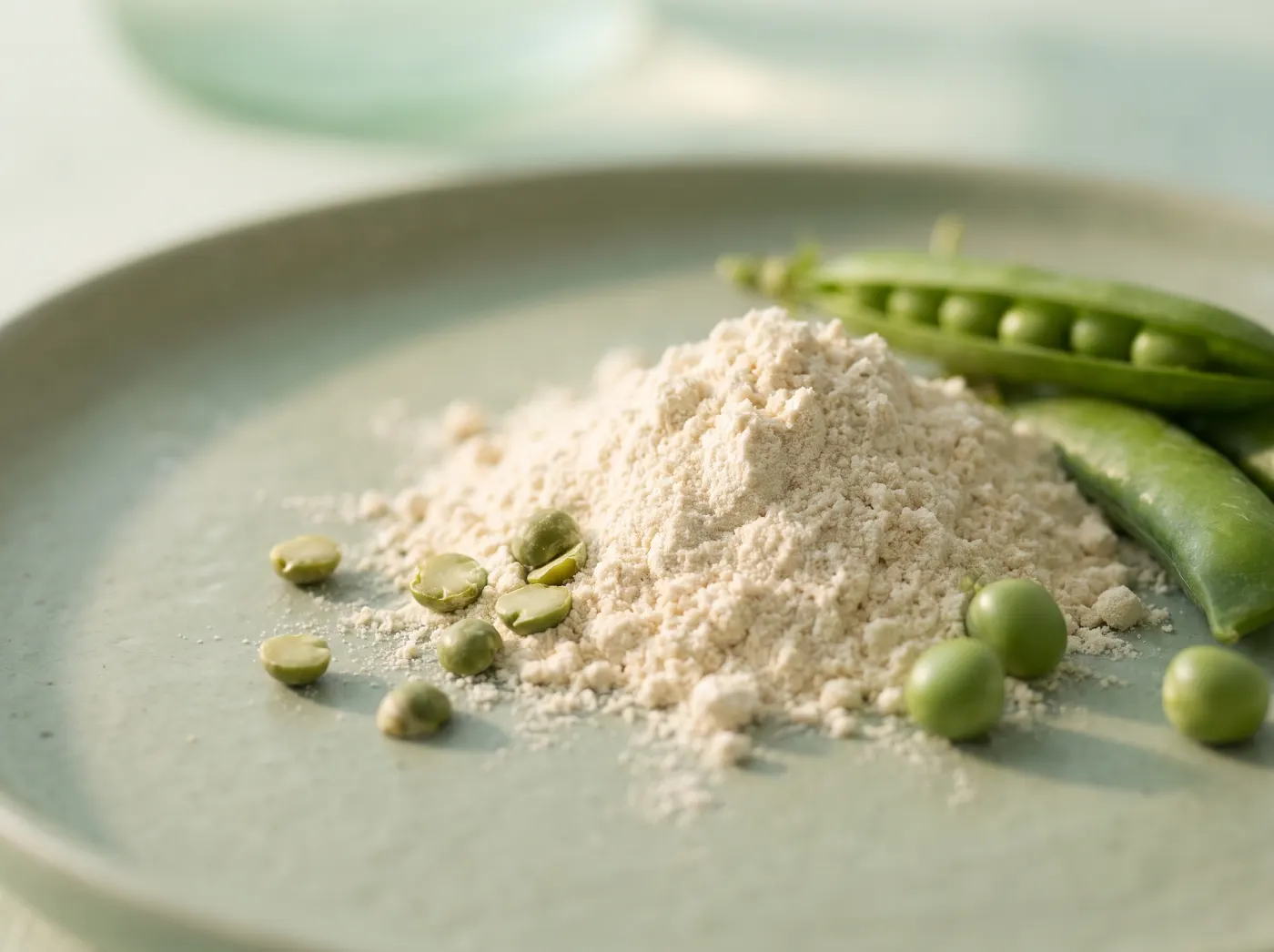
Beige pea protein powder in macro view on a sage green ceramic surface, raking light

Hydrolyzed pea protein at a glance

Entry from our cosmetic ingredient glossary. Regulatory data from the European Commission's CosIng database1. A non-hydrolyzed pea protein, common in food, is a different material: its studies do not carry over.

INCI name
HYDROLYZED PEA PROTEINDerivatives also exist: acylated, quaternized, silanetriol2
Other names
Pea protein hydrolysateHydrolyzed pea protein
CAS number
222400-29-5According to CosIng1
EC number
Not given in CosIng
CosIng description
Pea protein hydrolysateObtained by acid, enzymatic or other hydrolysis: the molecular weight of the peptides varies with the method1
Botanical origin
Pea (Pisum sativum)Legume
CosIng functions
Antistatic, skin conditioning (emollient), hair conditioning"Antistatic, skin conditioning - emollient, hair conditioning, skin conditioning"1
Appearance
Depends on the supplierRequest the technical data sheet
EU status
Permitted, no annexNo annex listed in CosIng1
Allergen to declare
NoNot a fragrance allergen. Pea is a legume: see the safety section
Safety
Family judged safe under conditions of useCIR panel 2022 on plant proteins; the summary does not list pea protein: to be confirmed3

What the research says

Each result shows the protocol and the level of evidence. The higher the level, the better the result carries over to a finished formula.

Clinical trialReview or consensusLaboratory

Material and formulationFormulation

Surfactant hydrolysates that can be tuned

Review
2001 reviewNon-food applications

Pea protein hydrolysates are surfactants with good emulsifying and foaming power. The type of enzyme and the degree of hydrolysis make it possible to adjust these properties4.

A pea isolate to encapsulate a fat-soluble active

Laboratory
2001 reviewBeta-caroteneIntended use: cosmetics

A pea isolate served as a microencapsulation matrix for beta-carotene, with supercritical CO₂, without organic solvent, under mild conditions4.

A hemp oil emulsion stabilized by a pea isolate

Laboratory
Non-hydrolyzed pea isolate and lecithinNanoemulsion made by ultrasound

Droplets measured 209 nm at preparation and 207 nm after one week, with up to 98.6% encapsulation of linoleic acid. The authors aim first at food and mention a possible cosmetic use5.

Facial skinSkincare

Xyloglucan and pea protein on keratinocytes

Laboratory
HaCaT cells in cultureProduct combining xyloglucan and pea proteinNo human study retained

The pretreatment increased transepithelial electrical resistance, a barrier marker, and reduced the passage of Lucifer yellow through the cell layer. The specific effect of pea protein is not isolated from xyloglucan6.

Safety and allergiesToxicology

19 plant proteins and peptides assessed

Expert assessment
CIR panel 2022Skin and hair conditioning agents

The panel concludes that 18 of the 19 ingredients are safe under the conditions of use described; data are insufficient for a single protein, the sycamore maple one. The summary does not name pea protein3.

Pea and peanut: a food cross-reaction

Case series
3 participants allergic to peaSkin tests, IgE, immunoblotExposure by ingestion

These participants' peanut symptoms came from cross-reactivity with pea vicilin (Ara h 1). The authors conclude that a clinically relevant cross-reactivity between pea and peanut exists. No data on skin application7.

Pea and legumes: a risk for allergic people

Clinical study
36 participants allergic to legumes or peanutSkin tests, ELISA, immunoblot

Among peanut-allergic people sensitized to legumes, 96% had IgE directed against Ara h 1. The authors identify a risk of pea allergy in people allergic to legumes and in some of those allergic to peanut8.

Skin exposure to food hydrolysates: a precedent

Epidemiological study
157 wheat allergy cases, 449 controlsFacial soap with hydrolyzed wheat protein

Adjusted odds ratio of 2.6 (95% confidence interval 1.2 to 5.7) for use of this soap. The result concerns wheat, not pea; it shows that a food hydrolysate can sensitize through the skin9.

This page summarizes published literature on a cosmetic ingredient. It does not describe the effect of a finished product, which depends on its formula, and it is not medical advice. The evidence is weak: we found no peer-reviewed trial on hydrolyzed pea protein alone, on skin or on hair. The results below are formulation and laboratory studies, plus food allergy data.

Which products can use hydrolyzed pea protein?

No formula in our white label catalog features hydrolyzed pea protein yet. Our formulation lab can add it to a custom formula or to a catalog formula. Its common uses:

Face

Creams and serums: skin conditioner with an emollient effect, supporting other actives.

Body

Body lotions and creams, with the same skin conditioning function.

Hair

Conditioners, masks and leave-ins: conditioning agent and antistatic, according to CosIng functions.

Frequently asked questions about hydrolyzed pea protein

What is pea protein in cosmetics?
It is a hydrolysate: pea protein is cut into peptides by acid, enzymatic or other hydrolysis1. The INCI is HYDROLYZED PEA PROTEIN, CAS number 222400-29-5. CosIng gives it three roles: antistatic, skin conditioning and hair conditioning1.
Is food pea protein the same as cosmetic pea protein?
No. Most published studies on pea protein concern food and non-hydrolyzed isolates5. The cosmetic version is a hydrolysate, whose peptides vary with the method1. These results do not carry over to a cosmetic formula without a dedicated test.
Is pea protein good for hair?
We found no peer-reviewed study on pea protein and hair. Its use in conditioners or masks rests on the conditioning function recognized by CosIng1, not on a trial.
What are the benefits for skin?
No human trial was retained. In the laboratory, a product combining xyloglucan and pea protein raised a barrier marker on cultured cells, without isolating the effect of the protein6. It is a lead, not proof of efficacy.
Is there a risk for people allergic to peanuts?
A cross-reactivity between pea and peanut has been documented for food, through vicilin78. We found no data on skin application of the hydrolysate. A Japanese study linked a facial soap with hydrolyzed wheat to a risk of wheat allergy9: caution applies to any formula aimed at an allergic audience.
Is pea protein safe?
The CIR panel judged 18 of 19 plant proteins and peptides safe under conditions of use; its summary does not say whether pea protein is one of them3. Ask the supplier for the safety file of the hydrolysate you choose.
Can you manufacture a pea protein product for my brand?
No formula in our catalog features pea protein yet, but our ISO 22716 certified laboratory can add it to a catalog formula or to a custom formula. Free samples are included.

Sources

Peer-reviewed studies and official regulatory sources, checked on November 3, 2026.

  1. European Commission. CosIng, entry HYDROLYZED PEA PROTEIN (CAS 222400-29-5). ec.europa.eu/growth/tools-databases/cosing
  2. European Commission. CosIng, entry HYDROLYZED PEA PROTEIN PG-PROPYL SILANETRIOL (silanetriol derivative). ec.europa.eu/growth/tools-databases/cosing
  3. Burnett CL, Boyer IJ, Bergfeld WF, et al.; Expert Panel for Cosmetic Ingredient Safety. Safety Assessment of Plant-Derived Proteins and Peptides as Used in Cosmetics Int J Toxicol. 2022;41(2_suppl):5S-20S. doi:10.1177/10915818221100700
  4. De Graaf LA, Harmsen PF, Vereijken JM, Mönikes M. Requirements for non-food applications of pea proteins. A review Nahrung. 2001;45(6):408-411. doi:10.1002/1521-3803(20011001)45:6<408::aid-food408>3.0.co;2-#
  5. Jarzębski M, Fathordoobady F, Guo Y, et al. Pea protein for hempseed oil nanoemulsion stabilization Molecules. 2019;24(23):4288. doi:10.3390/molecules24234288
  6. Campolo M, Lanza M, Filippone A, et al. Evaluation of a product containing xyloglucan and pea protein on skin barrier permeability Skin Pharmacol Physiol. 2020;33(4):231-236. doi:10.1159/000509372
  7. Wensing M, Knulst AC, Piersma S, et al. Patients with anaphylaxis to pea can have peanut allergy caused by cross-reactive IgE to vicilin (Ara h 1) J Allergy Clin Immunol. 2003;111(2):420-424. doi:10.1067/mai.2003.61
  8. Richard C, Jacquenet S, Sergeant P, Moneret-Vautrin DA. Cross-reactivity of a new food ingredient, dun pea, with legumes, and risk of anaphylaxis in legume allergic children Eur Ann Allergy Clin Immunol. 2015;47(4):118-125. PMID 26159477
  9. Fukutomi Y, Taniguchi M, Nakamura H, Akiyama K. Epidemiological link between wheat allergy and exposure to hydrolyzed wheat protein in facial soap Allergy. 2014;69(10):1405-1411. doi:10.1111/all.12481
Carmel Cosmetics Labs product specialist with a brand founder

Tell us about your project

A product specialist reviews your request and gets back to you on the channel you prefer.

Lead EN – Demande de devis
Tell us about your project. A product specialist will get back to you shortly.
CONTACT INFORMATION
Name
PROJECT INFORMATION
Which cosmetics category interests you most?

By submitting this form, you agree to our terms of service and privacy policy.

No obligation. Your information stays confidential and is used only to prepare your quote.