Services

Torn between two services?A project manager will guide you

Catalog

Explore the full catalog1,000+ formulas ready to carry your brand

Face careFull range

Serums, creams and targeted care, formulated with your actives.

Body careFull range

Moisturizing, nourishing and shower care: cream, butter or oil.

Specialty careFull range

Sun care, lips, intimate care and oral care.

Men, baby, makeupFull range

Shaving and beard, baby and mom, makeup.

Industries

All solutions by industryFormulas and formats for your business

Our brands

Our own brands, developed and made in our laboratory.

Become a distributor of our brandsPharmacies, spas, shops and wholesalers

Laboratory

Cosmetics manufacturing room with a row of stainless-steel mixers and an operator in white workwearOur factory in Aït MelloulISO 22716 and ISO 9001, visits by appointmentDiscover the factory

Resources

Hibiscus (Hibiscus sabdariffa)

The glossary's hibiscus is the flower powder of Hibiscus sabdariffa (roselle), classified as an abrasive by CosIng1. Roselle calyces are rich in anthocyanins, organic acids and polysaccharides2. We found no peer-reviewed cosmetic trial on this powder: the data cover composition, food safety and lab tests.

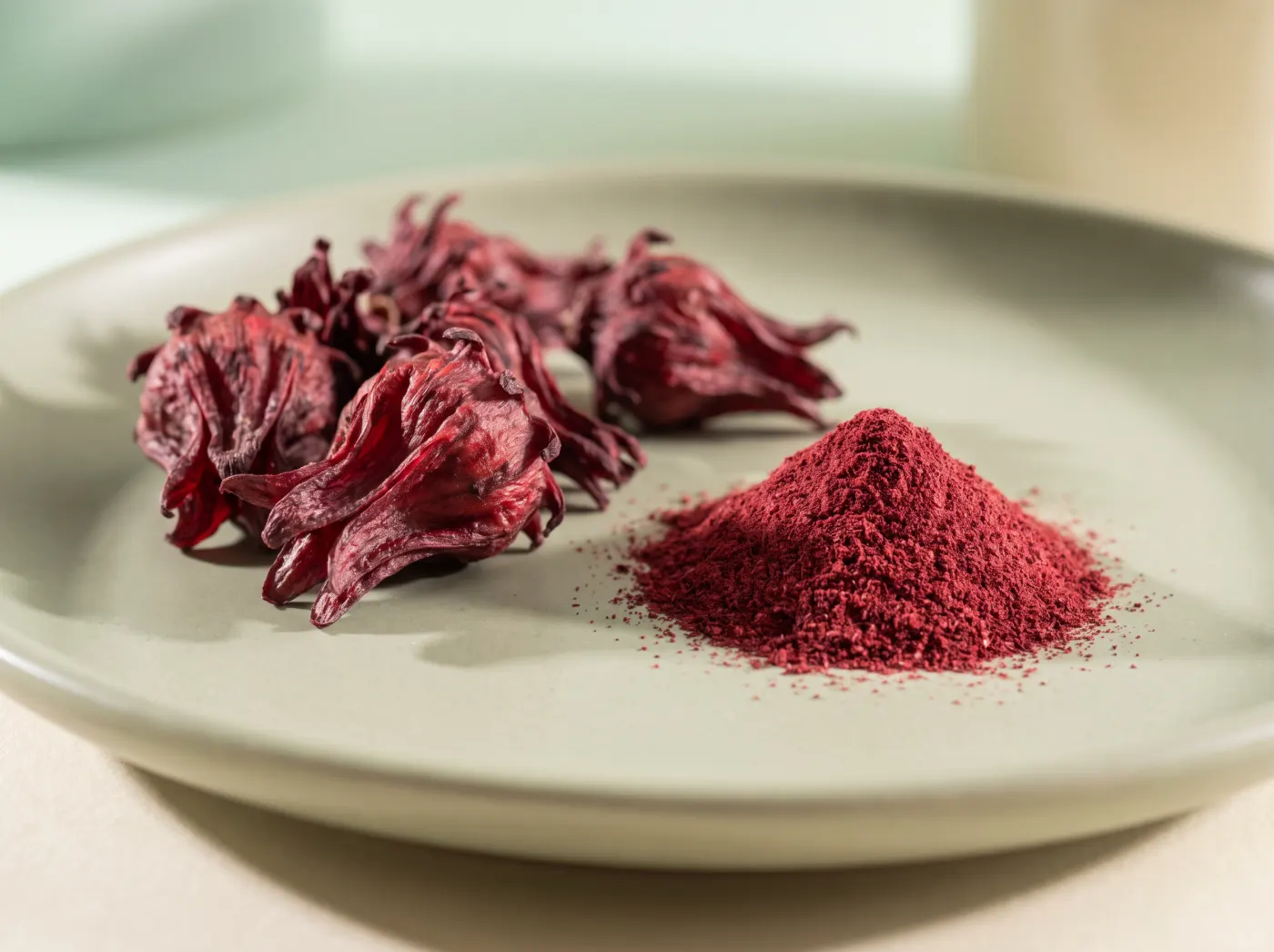
Dried red hibiscus calyces and hibiscus powder in macro on a sage green ceramic surface, raking light

Hibiscus at a glance

Entry from our cosmetic ingredient glossary. Regulatory data from the European Commission's CosIng database1. Copy the identifiers in one click for your files.

INCI name
HIBISCUS SABDARIFFA FLOWER POWDERHibiscus rosa-sinensis and Hibiscus syriacus are other species, with other INCI names
Other names
Roselle, red sorrel"Red Sorrel" in CosIng1; roselle in the literature2
CAS number
84775-96-2
EC number
283-920-7
Botanical origin
Flowers of Hibiscus sabdariffa L. (Malvaceae)« Powder obtained from the flowers of the Red Sorrel »1
CosIng function
Abrasive« Abrasive »1
Constituents
Anthocyanins, organic acids, polysaccharides, mineralsComposition of roselle calyces; varies with the cultivar2
Appearance
Dark red powderAnthocyanins are used as natural colorants in food; their stability in a cosmetic formula is not documented in our sources2
EU status
No specific restrictionNot listed in Annexes II to VI of Regulation (EC) 1223/2009, consolidated version of May 1, 20255
Allergen to declare
NoNot on the fragrance allergen list of Regulation (EU) 2023/15456. The review notes an almost complete lack of allergenicity data2
Safety
No CIR or SCCS assessment foundSafety of the finished formula is the responsibility of the safety assessor; ask for the certificate of analysis of each batch

What the research says

Each result shows the protocol and the level of evidence. The higher the level, the better the result carries over to a finished formula.

Clinical trialReview or consensusLaboratory

Material and formulationComposition

Roselle composition and points of caution

Review
2026 critical reviewHibiscus sabdariffa calyces, food and cosmetic uses

The calyces are rich in anthocyanins, organic acids, polysaccharides and minerals. The authors point out the variability of cyanogenic glycosides, gaps in microbiological monitoring and an almost complete lack of allergenicity data2.

A flower extract in a gel: release and stability

Laboratory
Flower extract in a nanoemulgelIn vitro release, 12-month stability

The extract is released at about 99% in 24 h. The sodium alginate gel stays stable for 12 months at 4-8 °C in glass; high temperatures and plastic packaging destabilize it4.


LaboratoryBiology

Antimicrobial activity measured in the lab

Laboratory
2024 reviewExtracts of hibiscus species, including H. sabdariffa

In the lab, the extracts act on bacteria such as E. coli and S. aureus and on the yeast C. albicans. The authors call for clinical trials and better extraction methods. This says nothing about the effect of a powder in a finished product3.

This page summarizes published literature on a cosmetic ingredient. It does not describe the effect of a finished product, which depends on its formula, and it is not medical advice. We retained no human trial, no cosmetic study on hibiscus powder, and none on hair. The data below cover composition, food safety and lab extracts.

Which products use hibiscus?

No formula in our white label catalog features hibiscus yet. Our formulation lab can add it to a custom formula or to a catalog formula. Its common uses:

Face

Scrubs and masks made with the flower powder, which brings a natural red color.

Hair

Colored masks and care products; no cosmetic study establishes an effect on hair.

Frequently asked questions about hibiscus

What is hibiscus powder in cosmetics?
It is the flower powder of Hibiscus sabdariffa (roselle), listed as HIBISCUS SABDARIFFA FLOWER POWDER, CAS 84775-96-2. CosIng gives it a single function: abrasive1.
What are the benefits of hibiscus for skin?
No peer-reviewed cosmetic trial on the powder was retained. The calyces contain anthocyanins, organic acids and polysaccharides2, and extracts show antimicrobial activity in the lab3. These data do not prove any effect on skin.
Is hibiscus powder useful for hair?
We found no peer-reviewed cosmetic study on hibiscus and hair. The powder can be formulated into a mask for its color, but no effect is established.
Does hibiscus powder color a product?
Roselle anthocyanins are used as natural colorants in food2. Their stability in a cosmetic formula is not documented in our sources: color is tested in the finished product, under light and heat.
What are the risks or restrictions?
The powder does not appear in any of Annexes II to VI of Regulation (EC) 1223/2009, consolidated on May 1, 20255. A review notes variable composition, gaps in microbiological monitoring and an almost complete lack of allergenicity data2: ask for the certificate of analysis of each batch.
Does hibiscus keep well in a formula?
For a flower extract in a nanoemulgel, stability was maintained for 12 months at 4-8 °C in glass, but it degraded at high temperature and in plastic packaging4. This result does not carry over as is to a powder: stability tests are run on your formula.


Can you manufacture a hibiscus product for my brand?
Yes. No formula in our catalog features hibiscus yet, but our ISO 22716 certified lab can add it to a customized catalog formula or to a custom formula. Samples are free.

Sources

Peer-reviewed studies and official regulatory sources, checked on November 3, 2026.

  1. European Commission. CosIng, entry HIBISCUS SABDARIFFA FLOWER POWDER (CAS 84775-96-2, EC 283-920-7). ec.europa.eu/growth/tools-databases/cosing
  2. Dada T, Neugart S, Engelhardt L. Edible Rose and Roselle: A Critical Review of Nutritional Composition, Safety, and Regulatory Considerations for Product Development J Food Sci. 2026;91(10):e71524. doi:10.1111/1750-3841.71524
  3. Alharbi AE, AlHussaini AM, Alshami I. A Comprehensive Review of the Antimicrobial Effects of Hibiscus Species Cureus. 2024;16(11):e73062. doi:10.7759/cureus.73062
  4. Mammadov BS, Mehraliyeva SJ, Sevinc Özakar R, et al. Engineering pectin- and sodium alginate-based nanoemulgels for topical delivery of Hibiscus sabdariffa flower extract RSC Adv. 2026;16(45):57258-57273. doi:10.1039/d6ra06448e
  5. European Parliament and Council. Regulation (EC) No 1223/2009 on cosmetic products, Annexes II to VI, consolidated version of May 1, 2025. eur-lex.europa.eu/eli/reg/2009/1223
  6. European Commission. Regulation (EU) 2023/1545 amending Regulation (EC) No 1223/2009 as regards labeling of fragrance allergens. eur-lex.europa.eu/eli/reg/2023/1545
Carmel Cosmetics Labs product specialist with a brand founder

Tell us about your project

A product specialist reviews your request and gets back to you on the channel you prefer.

Lead EN – Demande de devis
Tell us about your project. A product specialist will get back to you shortly.
CONTACT INFORMATION
Name
PROJECT INFORMATION
Which cosmetics category interests you most?

By submitting this form, you agree to our terms of service and privacy policy.

No obligation. Your information stays confidential and is used only to prepare your quote.