
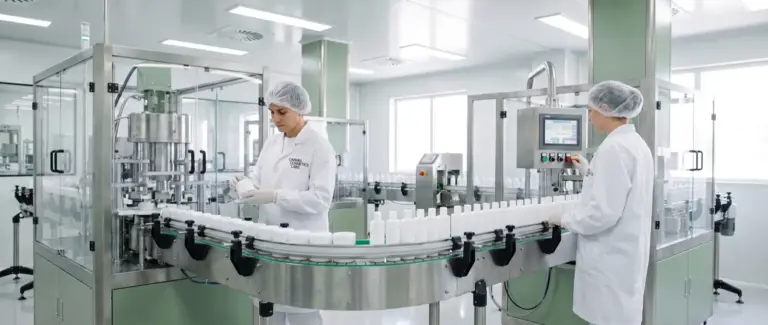
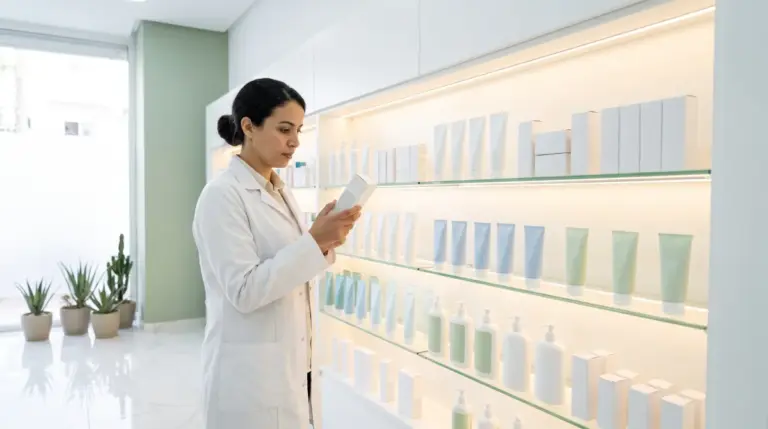
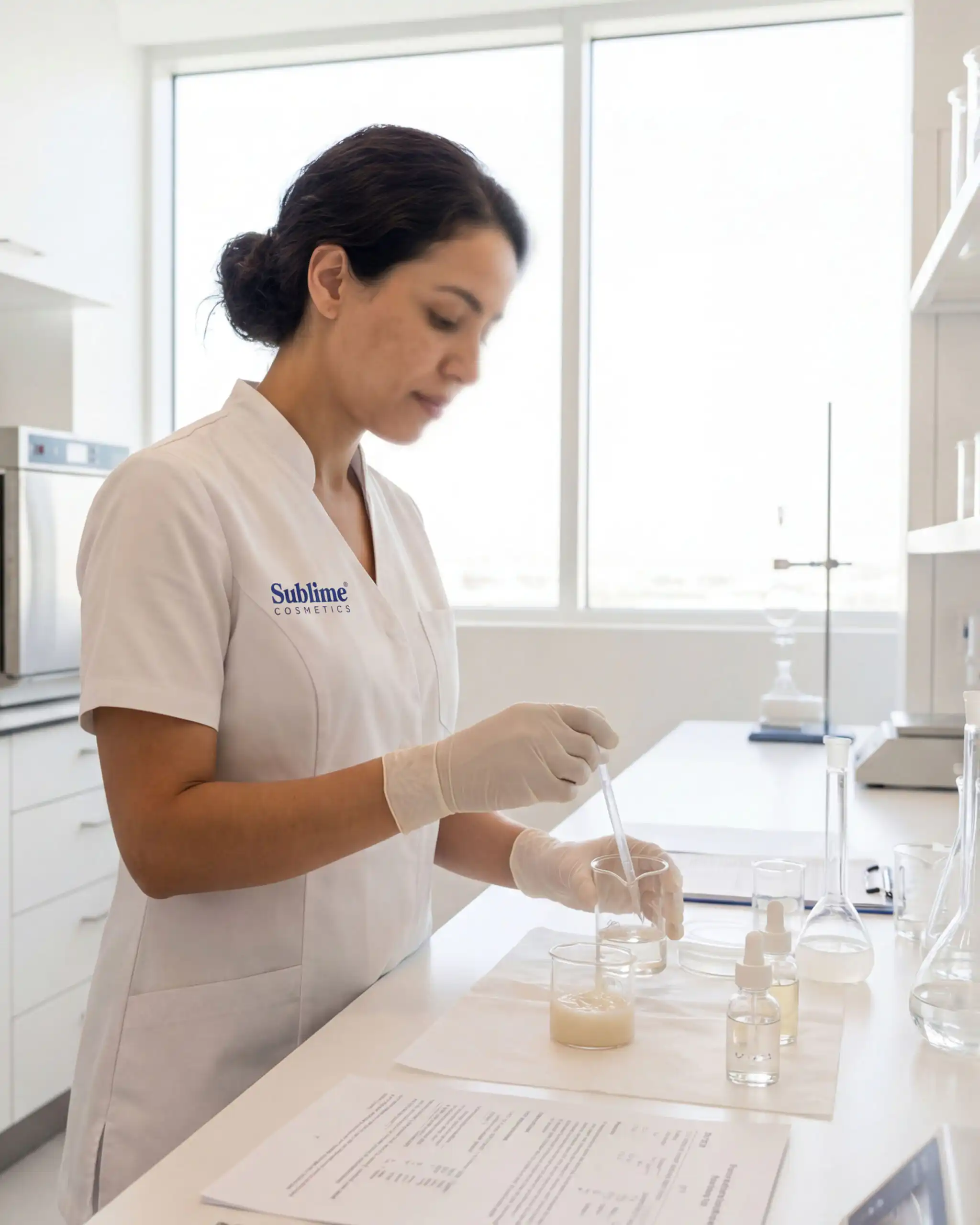
In short. In Morocco, the best cosmetics laboratories for custom formula development are the ones that combine five things: a real R&D team of qualified formulators, ISO 22716 compliance (Good Manufacturing Practices), full regulatory support (Regulation (EC) No 1223/2009 and Moroccan regulations), flexible production capacity from prototype to industrial run, and complete document traceability. The sector is split between craft laboratories focused on natural and organic products — mostly based in Marrakech — and science-led, industrial dermocosmetic laboratories such as Carmel Cosmetics Labs (Agadir), which supports more than 500 brands in 35 countries.
So there is no universal “best” laboratory: it depends on the nature of your project. This guide sets out objective evaluation criteria, maps the Moroccan market and helps you choose the right partner for your brand.
What is a custom cosmetic formulation laboratory?
A custom formulation laboratory (or contract manufacturer) designs an exclusive cosmetic formula from a product brief, then manufactures it on behalf of a brand. It differs from white label (ready-made formulas), where the brand puts its logo on an existing formula from the laboratory’s catalog.
In practice, a custom project covers the product’s entire life cycle:
- Feasibility study: technical, regulatory and economic review of the brief.
- Formula development by the formulators (galenics, active dosing, sensory profile).
- Prototyping and iterations until texture, fragrance and efficacy are approved.
- Testing: stability, packaging/product compatibility and safety (challenge test).
- Regulatory file preparation (PIF) and notification.
- Scale-up and production in line with GMP.
This approach suits brands that want a distinctive product identity, specific actives or claims that require a proprietary formula.
What criteria define the best cosmetics laboratories in Morocco?
To assess a laboratory objectively, seven criteria separate a basic contract filler from a true development partner.
| Criterion | Why it matters | What to check |
|---|---|---|
| 1. R&D expertise | A formula is only as good as its formulators’ skills in galenics and actives. | Formulators’ profiles, an in-house brand developed internally, a portfolio of complex formulas. |
| 2. Compliance & certifications | Essential to sell legally, especially for export. | ISO 22716 / GMP framework, ability to build the EC 1223/2009 file and the Moroccan notification. |
| 3. Production capacity & flexibility | Lets you move from prototype to large runs without changing partners. | MOQ offered, equipment, ability to scale up. |
| 4. Raw material sourcing | Determines access to high-performance actives and batch consistency. | Supplier network, access to patented actives, raw material quality control. |
| 5. Stability & safety testing | Guarantees compliance and product shelf life. | Stability tests, compatibility, challenge test, safety assessment. |
| 6. Confidentiality & formula ownership | Protects your most valuable asset: the formula. | Non-disclosure agreement (NDA), formula ownership clause in the contract. |
| 7. End-to-end support | Fewer handoffs and fewer contacts (formulation → packaging → regulatory → production). | A truly integrated “full service” offer, not subcontracted step by step. |
Rule of thumb: a laboratory that develops and sells its own brand offers concrete proof of its R&D capability — it does not just copy generic formulas.
Overview of cosmetics laboratories in Morocco
Morocco has become a cosmetics manufacturing hub in North Africa, driven by its expertise in natural ingredients (argan, ghassoul, plant oils) and competitive costs. Today the market is built around three complementary profiles.
Craft laboratories focused on natural and organic
Mostly concentrated in Marrakech and Casablanca, they specialize in 100% natural, certified organic formulas (often ISO 22716, sometimes ECOCERT). Well-known players include Cosmetiklab, Be Artisan and Biocylab. This profile suits natural cosmetics brands, spas and beauty salons looking for a craft-scale approach. Carmel Cosmetics Labs, based in Aït Melloul, also manufactures for riads, spas and hotels in Marrakech.
Science-led dermocosmetic laboratories
This profile targets dermatology-oriented skincare: actives dosed at effective concentrations, substantiated claims, formulas for sensitive or problem skin (dark spots, sun protection, microbiome). This is the positioning of Carmel Cosmetics Labs and its dermocosmetic brand Sublime, designed for the MENA market.
Laboratories with industrial capacity
For mass retail and high-volume export, the key criteria become production capacity and large-scale document compliance. Few Moroccan players cover dermocosmetic R&D and industrial capacity at the same time.
Carmel Cosmetics Labs: a dermocosmetic contract laboratory based in Agadir
Carmel Cosmetics Labs is a Moroccan cosmetics laboratory based in Agadir, specializing in custom dermocosmetic formulas. Its offer stands out on all seven criteria above.
- R&D expertise and an in-house brand. Carmel develops its own dermocosmetic brand, Sublime Cosmetics, built on proprietary formulation technologies (phototype intelligence, biomimetic microbiome care). It is direct proof of research capability, beyond simple contract filling.
- A scientific approach to actives. Formulas are built on justified concentration matrices (for example for dark-spot care), with a rigorous selection of UV filters and actives suited to the sensitive skin of the MENA market.
- Compliance and GMP. A new 2,500 m² production unit is being rolled out in the municipality of Drarga, designed to the ISO 22716 (GMP) standard.
- Full regulatory support. In-depth knowledge of Regulation (EC) No 1223/2009 and Moroccan regulations (Circular 771), for compliant files in Morocco and for export.
- Flexibility & track record. More than 500 brands supported in 35 countries, with white label, private label and bulk solutions — and an accessible MOQ depending on the format.
- MENA reach. Positioning and distribution designed for Morocco and the Gulf (dedicated distribution partnerships).
This profile is especially suited to brands aiming for a distinctive skincare / dermocosmetic positioning that need a partner combining scientific rigor and industrial capacity.
How do you choose the right laboratory for your project?
The choice depends above all on your brand’s profile. Here is a simple decision grid.
- Natural / organic cosmetics brand, craft-scale approach, “terroir” sensory profile. → Go for a craft laboratory focused on natural and organic (often in Marrakech), ideally ECOCERT certified.
- Dermocosmetic skincare brand (dosed actives, claims, sensitive skin). → Go for a laboratory with real scientific R&D and strong regulatory support, such as Carmel / Sublime.
- Retail distribution or high-volume export. → Go for a laboratory with industrial capacity and large-scale document compliance.
In every case, always ask for: the formulators’ profiles, proof of ISO 22716 compliance, the confidentiality policy (NDA) and the formula ownership clause.
How much does custom formula development cost in Morocco, and how is it planned?
There is no single price: the cost of custom development depends on formula complexity, the number and price of actives, the number of iterations, the testing required (stability, safety), packaging and production volume (MOQ).
As a guide, the typical process runs as follows:
- Brief and product specifications — the starting point of the project.
- Feasibility study and quote — the schedule is defined with you in the quote.
- Formulation and prototypes — the number of iterations depends on complexity.
- Stability and compatibility testing — monitored over time (stability kinetics).
- Regulatory file (PIF) and notification — in parallel.
- Scale-up and first production run.
On quantities, some laboratories offer a white label launch with an accessible MOQ, while a truly custom formula often involves a higher MOQ. Ask for an itemized quote (development, testing, packaging, production) so you can compare laboratories like for like.
FAQ — Cosmetics laboratories in Morocco and custom formulation
Which is the best cosmetics laboratory in Morocco for a dermocosmetic brand?
For a dermocosmetic positioning (dosed actives, claims, sensitive skin), choose a laboratory with scientific R&D and strong regulatory support. Carmel Cosmetics Labs, in Agadir, specializes in this segment and develops its own dermocosmetic brand, Sublime.
What is the difference between white label and custom formulation?
White label means selling an existing formula from the laboratory’s catalog under your logo. Custom formulation creates an exclusive formula from your brief: the actives, texture, fragrance and claims are unique to your brand.
Can a cosmetics laboratory in Morocco handle export compliance (EU, Gulf)?
Yes, as long as it masters Regulation (EC) No 1223/2009 (product information file, CPNP notification) and the regulations of the target markets. In Morocco, placing products on the market follows Circular 771 in particular. Check this regulatory expertise before you commit.
How long does it take to develop a custom cosmetic formula?
It depends on formula complexity, the number of prototype iterations and the stability testing required. The overall schedule up to the first production run also depends on packaging and approvals, and is defined with you in the quote.
What minimum order quantity (MOQ) applies to manufacturing in Morocco?
MOQs vary from one laboratory to another. A white label launch can start with an accessible MOQ; a fully custom formula generally involves a higher minimum volume. Ask for the exact MOQ for each product format.
Who owns the formula developed by the laboratory?
It depends on the contract. The best laboratories sign a non-disclosure agreement (NDA) and state in writing that the formula developed belongs to the brand. Insist on this clause before the project starts.