


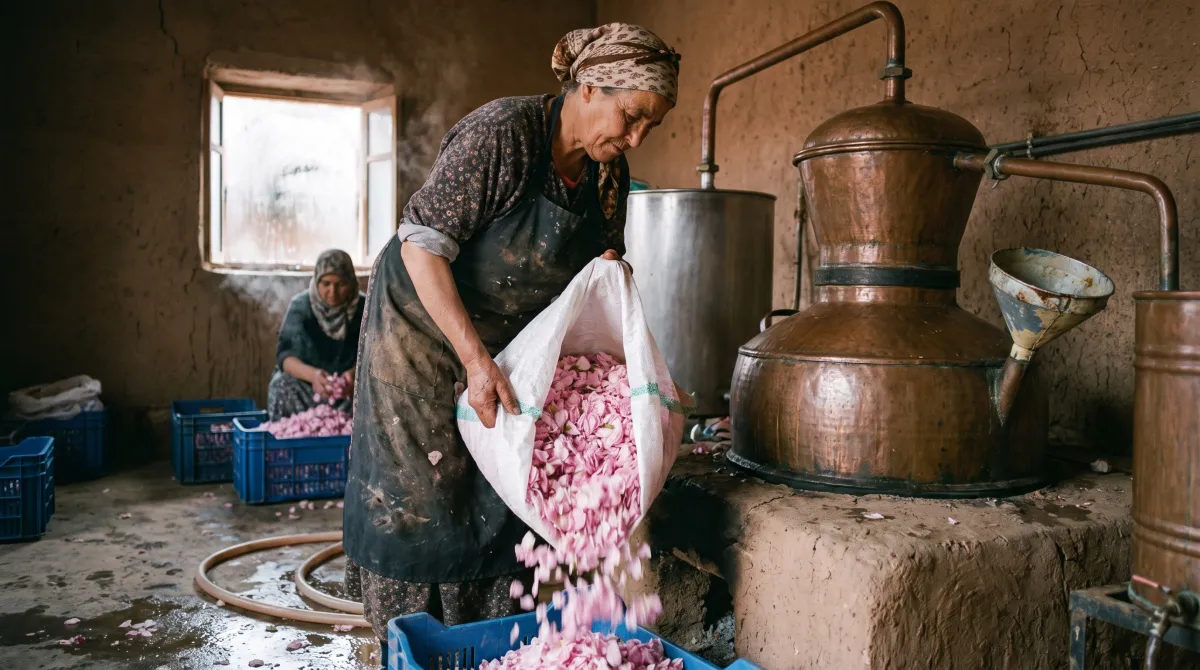
What is rose water? Real rose water is a hydrosol: the aromatic water collected during the steam distillation of Damask rose petals (Rosa damascena). On the label, it appears under the INCI name Rosa Damascena Flower Water, as the first ingredient. It refreshes, scents and conditions the skin, without being a miracle product.
Key takeaways
- Rose water, rose hydrosol and rose floral water are the same product when it is distilled. A mix of water and fragrance is not a hydrosol.
- In Morocco, “Eau de rose de Kelâa M’gouna-Dadès” is a protected designation of origin (PDO), whose specifications were revised in February 2026.
- The documented benefits are modest: antioxidant activity observed mainly in vitro, a fresh scent, skin conditioning.
- A pure hydrosol is fragile and should be kept cool after opening; in a formula, it is protected by a validated preservative system.
- For a brand, Moroccan rose hydrosol works in toners, mists, creams and masks, provided the INCI, allergens and preservation are under control.
What is rose water, and is it the same as a hydrosol?
Yes, real rose water is a rose hydrosol. A hydrosol is the aqueous phase obtained when a plant is steam-distilled, once the essential oil has been separated.
For Damask rose, distillation produces a little essential oil and a lot of scented water: Damask rose hydrosol. According to the Moroccan rose industry, 1 kg of petals can yield up to 2.5 liters of hydrosol (AgriMaroc, figure published in 2017), an order of magnitude that varies with the still and how the distillation is run.
Its main volatile compounds are phenylethyl alcohol, citronellol and geraniol, in proportions that vary with climate and process (Bayhan et al., 2020).
The name “rose water” is not reserved for hydrosols: it is also used to sell mixes of water and fragrance, which is why reading the ingredient list matters.
How do you spot real rose water on the label?
Real rose water lists Rosa Damascena Flower Water first, alone or followed by a preservative. The table below summarizes the three types of products sold under this name.
| Product type | Typical INCI | Process | Shelf life after opening |
|---|---|---|---|
| Pure Damask rose hydrosol | Rosa Damascena Flower Water (alone) | Steam distillation of the petals | Short: in the refrigerator, per the supplier’s PAO |
| Preserved floral water | Rosa Damascena Flower Water, then a preservative | Distilled hydrosol, stabilized | Longer, per the stated PAO |
| Reconstituted or scented water | Aqua, Parfum, solubilizer, preservative… | Water with added rose fragrance | Depends on the formula; this is not a hydrosol |
INCI (International Nomenclature of Cosmetic Ingredients) is the standardized ingredient naming that must appear on the packaging of every cosmetic sold in the European Union. The PAO (period after opening) is the time, shown by the open-jar symbol, during which an opened product can be used.
To check a bottle in a few seconds:
- Read the first ingredient: it should be Rosa Damascena Flower Water (or another rose, such as Rosa Centifolia Flower Water), not Aqua.
- Look for Parfum: it has no reason to be in a pure hydrosol. If Aqua and Parfum open the list, it is a scented water.
- Spot the declared allergens at the end of the list (Citronellol, Geraniol…): their presence is normal, because these molecules are part of the rose’s natural scent.
- Check the origin, the process (“steam-distilled”) and the PAO, especially for a preservative-free hydrosol.
In the European CosIng database, Rosa Damascena Flower Water is listed with the functions “masking”, “skin conditioning” and “skin protecting” (European Commission CosIng database). If you are aiming for a label, our guide to COSMOS, Ecocert and NATRUE labels details their requirements on ingredient origin.
What are the evidence-based benefits of rose water for skin?
The benefits of rose water for skin are real but modest: it refreshes, scents and conditions the skin, and Damask rose has antioxidant activity measured in the lab. What can be said with caution:
- Antioxidant: a scientific review of Rosa damascena reports antioxidant activity measured mainly in vitro, through chemical tests such as the DPPH method (Boskabady et al., Iranian Journal of Basic Medical Sciences, 2011). These tests concern extracts and oils, not a hydrosol applied to the skin.
- Freshness and comfort: rose hydrosol is traditionally used in skincare for its moisturizing and soothing properties, Bayhan et al. note. In cosmetics, we talk about how skin feels and looks, never about a therapeutic effect.
- Natural scent: a soft floral note, with no added synthetic fragrance.
One limitation is well documented: the Bayhan et al. study showed no significant antibacterial effect of the hydrosol on the skin flora of the hands, unlike an alcohol-based solution. So never present this product as “sanitizing” or “antibacterial”. Every claim must rest on evidence suited to the finished product: the framework is explained in our article on how cosmetic claims are regulated in the EU.
Can you use rose water on your face every day?
Yes, most skin types tolerate rose water on the face every day, morning and evening, as a toner after cleansing or as a mist, before serum or cream. It does not replace a makeup remover or a moisturizer.
Two precautions. Very reactive skin may not tolerate the rose’s natural scent molecules, such as citronellol and geraniol, classified as fragrance allergens in the European Union. And a pure hydrosol that has been open for a long time or stored somewhere warm can become contaminated: a sour smell, cloudy appearance or sediment means it should be thrown away.
Why is Moroccan rose water (Kelâat M’Gouna) so renowned?
Moroccan rose water is renowned because it comes from an identified terroir, the Dadès valley around Kelâat M’Gouna, protected by a designation of origin. A PDO (protected designation of origin) is an official label that reserves a name for products made in a defined area according to controlled specifications.
The Moroccan Ministry of Agriculture lists two PDOs in the sector: “Rose de Kelâa M’gouna-Dadès” and “Eau de rose de Kelâa M’gouna-Dadès” (Ministry of Agriculture, perfume rose sector). For 2019, it reports 950 hectares under cultivation and 3,900 tonnes of roses in Drâa-Tafilalet.
The specifications for the PDO floral water were amended by a decision published in February 2026. According to the Moroccan business press, they require distillation exclusively of Rosa damascena petals from the area, picked early in the morning in April and May, a pH between 3 and 5.4, no ethanol, and a resting period before bottling (Libre Entreprise, February 5, 2026).
At the opening of the 61st Rose Festival in May 2026, the harvest was estimated at about 5,000 tonnes of perfume roses, compared with an average of 3,700 tonnes, for some 6,000 farmers across 7 rural communes; the Generation Green 2020-2030 strategy targets 6,000 tonnes a year and 70% local processing (7news, May 8, 2026). Rose thus joins argan, rhassoul and prickly pear seed oil, another flagship Moroccan active, among the Moroccan cosmetic traditions that brands showcase.
How should rose water be stored, and how long does it keep?
A pure rose hydrosol keeps in the refrigerator, tightly closed and away from light, and should be used quickly after opening. Stated shelf lives vary from one supplier to another, up to six months refrigerated for some (Naturellement Bio): always follow the PAO on the bottle.
Water is a favorable environment for microorganisms, so a preservative-free hydrosol remains the most fragile product.
In a finished product, hydrosol added to a cream or toner is protected by the formula’s preservative system. The challenge test is the test that checks a formula can withstand deliberate microbial contamination over several weeks. It is one of the checks described in our guide to testing the quality of your cosmetic products.
How does a brand use rose water in a formula?
Rose water most often replaces all or part of the water in a formula: it brings its floral note and an origin story without changing the texture. Common white label uses:
- Toner and lotion: the hydrosol is the base, completed by a humectant such as glycerin and a compatible preservative.
- Face and body mist: a very simple formula, where the scent quality of the raw material is noticeable immediately.
- Cream and gel-cream: the hydrosol replaces the water in the emulsion’s aqueous phase.
- Rhassoul mask: the floral water rehydrates the clay, a traditional pairing in Morocco.
Two regulatory points need planning. Allergens from the rose add up with those of any fragrance and must be declared above 0.001% in a leave-on product and 0.01% in a rinse-off product. Regulation (EU) 2023/1545 extended the list of these allergens, applying to new products since July 31, 2026 (Regulation (EU) 2023/1545, EUR-Lex); our article on fragrance allergen disclosure in the EU, Canada and the US details these rules. In addition, using the PDO name on the label requires traceable sourcing that complies with the specifications.
The manufacturer’s view
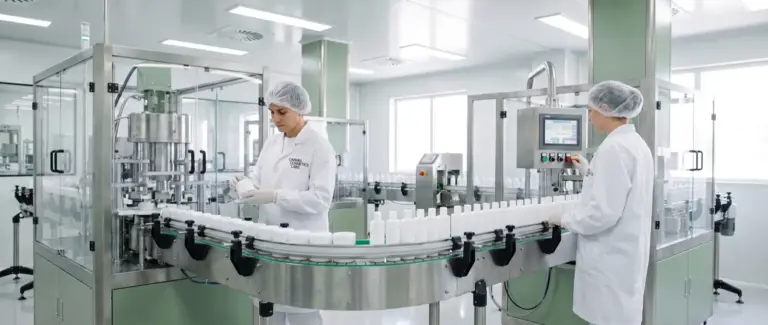
Simple as it looks, rose water carries several compliance risks. Carmel Cosmetics Labs, an Agadir-based laboratory certified ISO 22716 and ISO 9001, works with Moroccan actives: argan oil, prickly pear, henna, rhassoul and rose water. Our advice for a rose skincare project: For riads, spas and hotels, these actives can become products under their own brand, made for Marrakech.
- Require the raw material documents: technical data sheet, batch certificate of analysis, allergen composition and botanical origin.
- Do not confuse trade name and INCI: a “rose water” whose INCI starts with Aqua cannot claim to be a pure hydrosol.
- Formulate for preservation: a preservative-free mist is a risky bet. Stability and challenge tests are validated on the final packaged formula.
- Stay within cosmetic claims: freshness, comfort, radiance, scent. Medical promises are prohibited for a cosmetic, in Europe and in the US alike.
Carmel manufactures white label products with an accessible MOQ, in compliance with Regulation (EC) No 1223/2009 and FDA requirements for export, and has already supported 500+ brands in 35+ countries.
Frequently asked questions
What is the difference between rose water and rose essential oil?
Both come from the same distillation of Damask rose petals. The essential oil is the oily fraction, highly concentrated in scent molecules and produced in tiny amounts. The hydrosol is the aqueous phase, much gentler. Essential oil is used at very low doses in formulation, while the hydrosol can make up the entire aqueous base of a toner or mist.
Is rose water suitable for sensitive skin?
It is generally well tolerated, but it naturally contains citronellol and geraniol, recognized as fragrance allergens. Reactive skin or skin allergic to fragrance may therefore react. Test the product first on a small area, such as the inside of the elbow, for forty-eight hours. If redness or itching occurs, stop and choose a formula without fragrance or floral water.
Can you make rose water at home?
Steeping petals in water gives you an infusion, not a distilled hydrosol: its composition is not controlled and it becomes contaminated within days, even in the refrigerator. At best it suits occasional personal use. A product for sale needs a distilled, tested raw material incorporated into a formula whose preservation has been validated.
Is all Kelâat M’Gouna rose water PDO-certified?
No. Only products that meet the specifications of the “Eau de rose de Kelâa M’gouna-Dadès” designation may use that name. A hydrosol produced elsewhere in Morocco, or in the valley without following the designation rules, may be of good quality but cannot claim the PDO. Ask the supplier for proof of compliance and batch traceability before using this mention.
Conclusion
Real rose water is a distilled hydrosol, identifiable by the INCI Rosa Damascena Flower Water at the top of the list, with measured cosmetic benefits. The Kelâat M’Gouna-Dadès PDO and the larger 2026 harvest make it an ingredient of choice for a brand that wants to tell Morocco’s story.
Want to launch a toner, mist or cream with Moroccan rose? Talk to a cosmetics manufacturer in Morocco specializing in local actives, or explore our white label manufacturing service, with an accessible MOQ, to book your free consultation.