




In the hyper-competitive beauty ecosystem, the gap between an attractive marketing promise and the reality of a finished product is a chasm that only scientific rigor can bridge. While strategic ideation today leans on “star” actives such as Bakuchiol, Niacinamide or CBD, the viability of an innovation does not rest on the popularity of its ingredients but on mastering its technical complexity. Why do some iconic launches last while others fail before they even break even? As a cosmetics strategy expert, I can say the answer lies in an invisible preparation: the move from the lab bench to industrial scale.
A cosmetic product specification (or brief) is the reference technical document that defines every specification of a product before manufacturing: formula and INCI list, expected performance, packaging, regulatory constraints for the target markets and industrial feasibility. It is what turns a marketing idea into a finished product that is compliant, safe and reproducible at scale. Well written, it secures your investment and smooths your collaboration with your cosmetics laboratory. Here are the 5 scientific levers that make the difference — and how to create your cosmetics brand with a laboratory.
1. The Specification: When Marketing Speaks the Language of Science
A specification is not a simple list of intentions; it is the founding document that secures your investment. As the industry framework puts it, “this technical document translates a marketing concept into quantifiable scientific specifications”. It is the brand’s insurance policy against formulation drift.
This rigor starts with surgical segmentation of the target. A baby cream is not just a “light cream”: it is a formula whose physicochemical structure accounts for the immaturity of the skin barrier, which calls for minimalist emulsions. For pregnant women, the precautionary principle becomes an absolute formulation rule, requiring the systematic exclusion of substances suspected of systemic toxicity, synthetic fragrances and certain essential oils. Without this framework, the formulator is flying blind, and regulatory risk becomes uncontrollable.
2. Packaging Is More Than a Case: The Hidden Chemistry of the Bottle
Choosing primary packaging is a toxicological safety decision long before it is an aesthetic one. Regulation (EC) No 1223/2009 requires the container to protect the formula without altering its organoleptic properties. In my consulting role, I insist on controlling three container-content interaction phenomena:
- Sorption: Polymer walls can “drink” your lipophilic actives or fragrance molecules, ruining the product’s efficacy and scent.
- Permeation: Gas exchange between outside and inside can cause premature rancidity of fats and oils.
- Migration: The transfer of non-intentionally added substances (NIAS) — residual monomers or heavy metals — from the packaging into the cream.
To mitigate these risks, advanced analyses such as GC/MS (gas chromatography coupled with mass spectrometry) are essential, especially when using post-consumer recycled plastics (PCR).
Expert note: the secret of glass If you opt for glass, an “exudation haze” may appear after 6 months of storage. This physical phenomenon, linked to the intrinsic chemical composition of glass, is perfectly normal and in no way represents a compliance defect or a toxicity risk.
Finally, logistics imposes its own thermal constraints: to avoid mechanical failure, Surlyn containers should not be exposed to more than 50°C, while PP or PET bottles should stay below 45°C.
3. The Label Maze: Telling a Standard from a Certification
A classic strategic mistake is confusing the ISO 16128 standard with an organic label. While ISO 16128 lets you claim a percentage of natural origin, it does not impose the strict restrictions of labels. For a brand, choosing a side is a decision about chemical purity.
| Technical criteria | COSMOS Organic | Nouvelle Cosmétique label | Nature & Progrès mention |
| Organic thresholds | Min. 20% of the finished product | 100% organic oils and glycerin | Maximum use of organic materials |
| Synthetic chemistry | Restrictive list (preservatives, pH) | Allowed only if no substitute exists | Total, systematic refusal |
| Animal origin | No killing of the animal | Approved bee products and milks | Slaughter fats excluded |
| UV filters | Mineral only | TiO2 and ZnO accepted | Synthetic filters banned |
| Manufacturing processes | GMOs and irradiation excluded | Heavy processing excluded | Agroecology promoted |
Choosing the “Nature & Progrès” mention is the most radical positioning, rejecting any synthetic chemistry, whereas COSMOS allows pH adjusters or specific preservatives when no viable alternative exists.
4. The Geography of Beauty: The Illusion of a Universal Formula
Trying to conquer the world with a single formula is a regulatory fantasy. Defining your geographic scope at the design stage is essential. In the United States, the shift to MoCRA (Modernization of Cosmetics Regulation Act) brings new purity criteria and FDA registration requirements. At the other end, the Chinese market demands specific ingredient nomenclatures and strict local declarations of conformity. Ignoring these differences from the outset exposes you to customs blocks or a costly emergency reformulation.
5. Industrial Scale-Up: The Real “Trial by Fire”
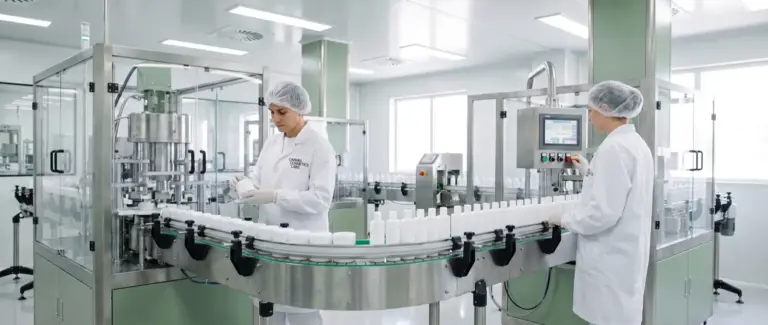
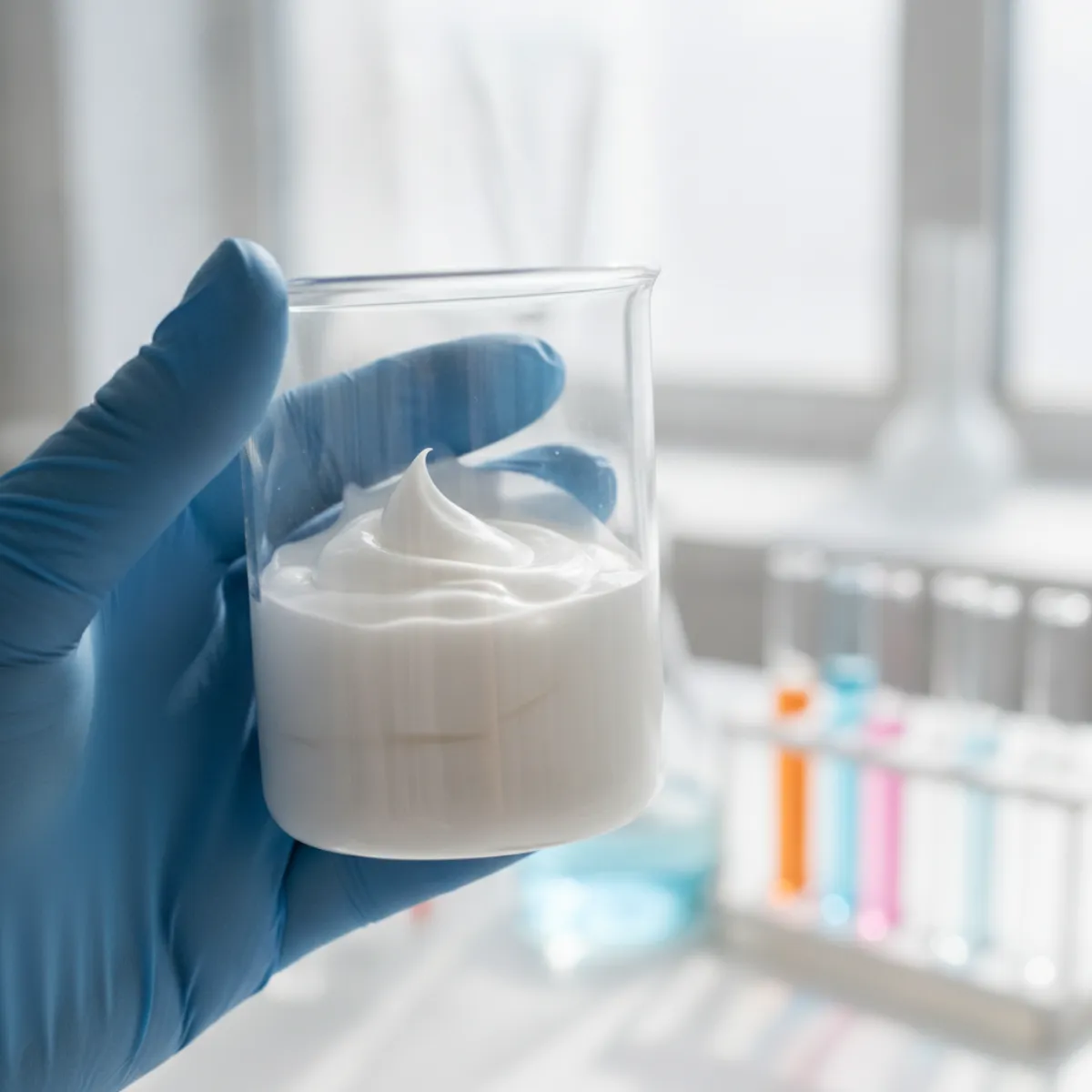
The best-kept secret of successful launches is the pilot batch (50 to 100 kg) phase. This is where industrial scale-up is validated: the mechanical shear rate of the emulsifiers and the cooling kinetics are tested. A failure at this stage means your silky lab cream could turn into an unstable liquid in a 2-ton tank.
To secure the product’s future, it must “survive” an uncompromising battery of tests:
- Accelerated stability: 12 weeks at 40–45°C to simulate 3 years of aging (pH and viscosity monitoring).
- Challenge test: Deliberate inoculation with bacteria and molds to validate the preservative system.
- Photostability test: Exposure to 1.8 million lux-hours to make sure light degrades neither color nor scent.
- Patch test: Validation of skin safety under dermatological supervision.
FAQ — Cosmetic product specification
What is a cosmetic product specification?
It is the technical document that brings together all the specifications of a cosmetic product (formula, INCI, packaging, target markets and regulations, industrial constraints) to guarantee a finished product that is compliant, safe and reproducible.
What should a cosmetic product specification contain?
At a minimum: the concept and expected performance, the formula and INCI list, the type of packaging, the targeted claims and labels, the target markets and their regulations (EU, MoCRA in the United States…), plus the manufacturing and industrial scale-up constraints.
Who writes the specification for a cosmetic product?
It is built by two parties: the brand expresses its vision and claims, and the cosmetics laboratory brings scientific, regulatory and industrial feasibility. Our white label service supports you from writing the specification to the finished product.
Read also: why choose Carmel as your cosmetics manufacturer in Morocco.
Conclusion: From Lab Bench to Shelf, a Balance of Precision
A cosmetic product’s success is not decided during the launch campaign, but in the rigor of its regulatory and industrial preparation. Between drafting the Cosmetic Product Safety Report (CPSR) and strictly following the ISO 22716 standard (Good Manufacturing Practice), there is no margin for error. Remember that in France, the Responsible Person has only 20 days to report any Serious Undesirable Effect (SUE) to ANSES.
Cosmetics is a science of precision in which every detail — from the purity of reverse osmosis water to the traceability of the batch record — contributes to consumer safety.
Now that you know the invisible complexity behind your favorite cream, which criterion — radical purity, packaging control or international compliance — will become your top priority for your next development?