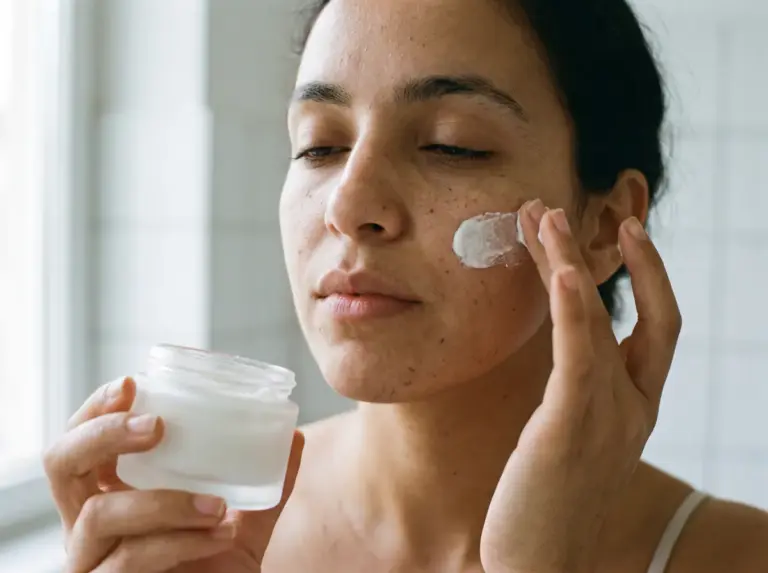








For hair and scalp
Added to a shampoo, lotion or serum, it brings a warm woody note and a clean, fresh feel to the scalp. It is a natural fit for care for oily-prone hair.
Services
Catalog
An active in mind?Ingredients glossaryIndustries
Laboratory
 Our factory in Aït MelloulGreater Agadir, Morocco
Resources
 Study: dermocosmetics in MoroccoA MAD 2.77 billion market
The cedar forest the Middle Atlas forests, around Azrou and Ifrane.
The Atlas cedar an endemic tree with tiers of blue-green branches.
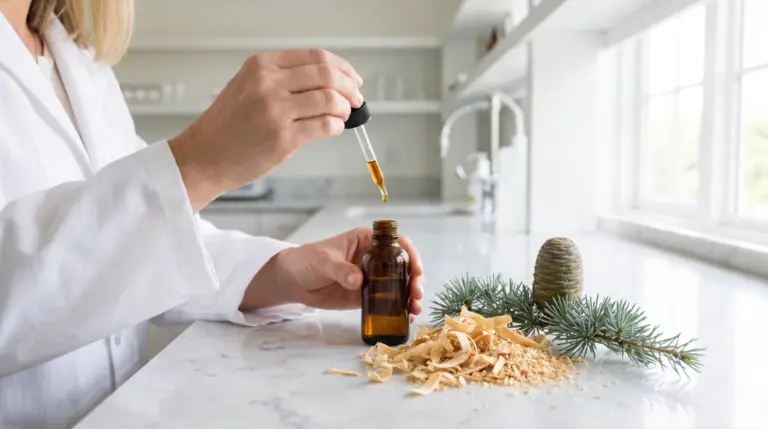
The wood chips and sawdust, distilled to extract the essence.
The essential oil amber, woody, always diluted in the formula.
By the Carmel Cosmetics Labs R&D team · updated October 2, 2026
Atlas cedarwood essential oil is obtained by distilling the wood of Cedrus atlantica, a conifer endemic to the mountains of Morocco and Algeria. It is made up mainly of sesquiterpenes, the himachalenes, and of ketones called atlantones, which give it its warm, woody, slightly balsamic scent. In cosmetics, it is used as a fragrance ingredient in hair, scalp and body care.
Oil distilled from cedar sawdust from a sawmill in Azrou (Annemer et al., ACS Omega, 2023), values rounded to the nearest unit; deodarone (about 11%) completes the profile. Composition varies widely with the wood, origin and distillation; the certificate of analysis for each batch is the reference.
Cedrus atlantica, a true cedar (pine family, Pinaceae), endemic to Morocco and Algeria. Oil rich in himachalenes and atlantones. INCI: CEDRUS ATLANTICA BARK OIL. This is the one in our products.
Juniperus virginiana: despite its name, a North American juniper (Cupressaceae), not a true cedar. Its oil has a different composition and is labeled JUNIPERUS VIRGINIANA OIL.
Cedrus deodara, a true cedar and a close cousin of the Atlas cedar. Its oil is distilled from the tree stumps. INCI: CEDRUS DEODARA WOOD OIL.
Added to a shampoo, lotion or serum, it brings a warm woody note and a clean, fresh feel to the scalp. It is a natural fit for care for oily-prone hair.
Diluted in a plant oil, it gives massage oils a woody, resinous note, popular for invigorating body massages.
It is first a fragrance ingredient: the European CosIng database lists its functions as perfuming and skin conditioning. A long-lasting base note, it adds depth to lighter accords such as citrus or lavender.
Already diluted in a shampoo, lotion or scalp serum, never neat on the skin.
In a massage oil, diluted in a plant oil such as argan oil.
At a very low dose, as a fragrance note in a cream, once the product's safety has been assessed.
It scents our soothing scalp serum (optional), our cedar cinnamon massage oil, hair oils and face creams. Choose a category to see the formulas ready to carry your brand.
What our formulators consider when Atlas cedarwood essential oil goes into your product.
Since Regulation (EU) 2023/1545, Atlas cedar oil is listed in Annex III: above 0.001% in a leave-on product or 0.01% in a rinse-off product, it must appear in the INCI list.
An essential oil is never used neat: we dose it in the oil phase or with a solubilizer, at a level approved by the safety assessor in the product information file.
Regulations require a peroxide value below 10 mmol/L for the oil itself: we check it on receipt and store the oil away from air and light.
The Atlas cedar is listed as endangered: its origin and supply chain are documented in the product file before being highlighted on the packaging.
The Atlas Cedar Biosphere Reserve joined UNESCO's world network: 1,375,000 hectares that are home to 75% of the world's Atlas cedars.
Since 2013, the IUCN Red List has classed the Atlas cedar as an endangered species, threatened by overexploitation and pests.
Near Azrou, the Gouraud cedar, more than 800 years old, still stands although it has dried out, and draws tens of thousands of visitors every year.
The Atlas cedar (Cedrus atlantica) is a conifer of the pine family (Pinaceae), endemic to the mountains of Morocco and Algeria. In Morocco, it forms the great cedar forests of the Middle Atlas, around Azrou and Ifrane. Distilled, its wood yields a woody essential oil used in cosmetics.
In cosmetics, it is above all a fragrance ingredient: it adds a warm, woody, long-lasting note to hair, scalp and body care. In a shampoo or serum, it leaves a clean, fresh feel; in a massage oil, a resinous scent. It is always used diluted.
Choose a product that already contains it diluted: shampoo, lotion, scalp serum or hair oil. The essential oil is never applied neat to the scalp. Do a patch test on a small area before first use.
It is never used neat on the skin and should be kept out of the reach of children. It is a regulated allergen in Europe: its presence is shown in the INCI list above 0.001% in a leave-on product. During pregnancy or for a child, ask a healthcare professional for advice.
The Atlas cedar (Cedrus atlantica) and the Himalayan cedar (Cedrus deodara) are true cedars, of the pine family (Pinaceae). "Virginian cedar" is actually a North American juniper, Juniperus virginiana. Their essential oils have different compositions and different INCI names.
Atlas cedarwood essential oil is most often listed under the INCI name CEDRUS ATLANTICA BARK OIL; CEDRUS ATLANTICA WOOD OIL is also used. This is the name that appears in the ingredient list on the packaging.
Yes. We use it in scalp serums, hair oils, massage oils and creams as white label, or in an exclusive private label formula, made in our factory in Morocco.
Send us your brief: we formulate and manufacture in our ISO 22716 factory in Aït Melloul. Free consultation and formula selection, with no commitment.