






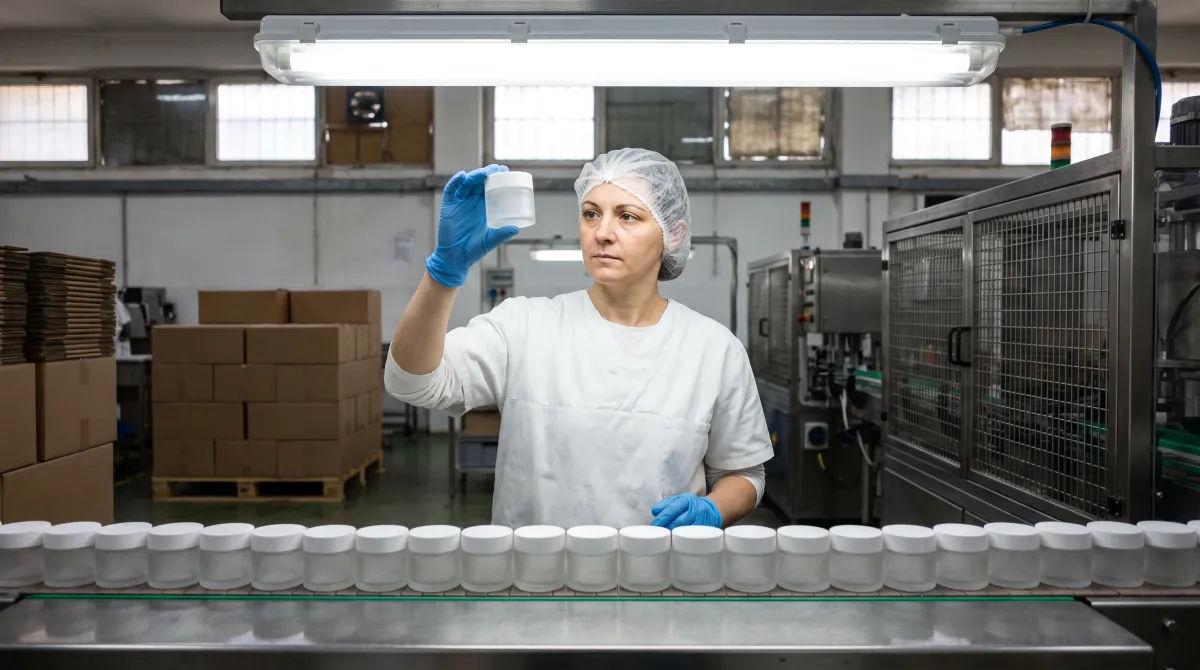
The PPWR (Regulation (EU) 2025/40) has applied since August 12, 2026 to all packaging sold in the EU, including cosmetic bottles, jars, tubes and cartons. Every package must already meet the 100 mg/kg heavy metals limit and have technical documentation and an EU declaration of conformity. Harmonized labeling follows in 2028, recycled content in 2030.
The essentials at a glance
- The PPWR replaces Directive 94/62/EC and has applied without transposition since August 12, 2026.
- Immediate obligations: heavy metals ≤ 100 mg/kg, substances of concern minimized, technical documentation and an EU declaration of conformity.
- The PPWR’s PFAS limits target food-contact packaging, not cosmetic packaging.
- In white label, the brand that has products made under its name is the “manufacturer” under the PPWR, even if the product comes from Morocco.
- Next deadlines: harmonized labeling (August 2028), then recyclability, minimization and 10 to 30% recycled plastic (2030).
What exactly is the PPWR?
The PPWR (Packaging and Packaging Waste Regulation) is the EU regulation that sets sustainability, labeling and end-of-life requirements for all packaging sold in the Union. It is Regulation (EU) 2025/40 of December 19, 2024, published on January 22, 2025, in force since February 11, 2025 and applicable since August 12, 2026 (Article 71).
Unlike a directive, it applies as is in every Member State. According to the European Commission, the EU generated 186.5 kg of packaging waste per inhabitant in 2022, and 40% of the plastics used in the EU go into packaging. The PPWR aims to cut packaging waste per inhabitant by 5% by 2030, 10% by 2035 and 15% by 2040 compared with 2018 (Article 43).
Under the PPWR, cosmetic packaging covers any unit that contains, protects or presents the product: bottle, pump, jar, tube, carton, grouped outer box and e-commerce parcel. Annex II even mentions glass “bottles and jars for cosmetic products”.
What has been mandatory since August 12, 2026?
Since August 12, 2026, cosmetic packaging can only be placed on the EU market if it is compliant, documented and identifiable.
1. The 100 mg/kg heavy metals limit
Article 5 caps the sum of lead + cadmium + mercury + hexavalent chromium in the packaging and its components at 100 mg/kg. The threshold already existed under Directive 94/62/EC, but it must now be demonstrated in the technical documentation. Sensitive points: colored glass, carton inks, pigments and metallic decorations.
2. Reducing substances of concern
A substance of concern, as defined by Ecodesign Regulation (EU) 2024/1781 to which the PPWR refers, is a substance harmful to health, the environment or recycling. Article 5 requires its presence to be minimized; a Commission report expected at the end of 2026 could lead to new restrictions.
3. Technical documentation and the EU declaration of conformity
The PPWR EU declaration of conformity is the document in which the manufacturer certifies, under its sole responsibility, that the packaging meets Articles 5 to 12 of the regulation. It relies on technical documentation (Annex VII, “Module A”): description, materials, standards applied, test reports.
It is drawn up per packaging type (Annex VIII template) and kept for five years for single-use packaging, ten years if reusable. When an authority requests them, the documents must be provided within ten days (Article 15).
4. Identification and traceability
Article 15 requires a type, batch or serial number and the manufacturer’s name and postal address (on the packaging, via a QR code or in an accompanying document). These details partly overlap with those of Regulation (EC) No 1223/2009 (responsible person, batch number).
PPWR declaration of conformity: what should your file contain?
The PPWR compliance file for cosmetic packaging gathers evidence from each component supplier, whom Article 16 obliges to pass on all necessary information.
| Component | PPWR watch point | Document to request from the supplier |
|---|---|---|
| Glass bottle or jar | Heavy metals (colored glass, decorations) | Pb/Cd/Hg/Cr VI test report, material data sheet |
| Plastic bottle, jar or tube | Additives, colorants, future recycled content | Material declaration (PE, PP, PET…), heavy metals tests |
| Pump, spray, cap | Multi-material assembly, metal spring | Bill of materials, heavy metals statement |
| Paperboard carton | Inks, varnishes, hot-foil stamping, lamination | Inks/varnishes statement, board weight, technical data sheet |
| Grouped outer box or parcel | Empty space (future 50% limit) | Internal dimensions, cushioning material |
The approach we recommend:
- List every packaging reference (including sizes and decorations).
- Break each reference down into components: container, closure, label, carton, cushioning.
- Ask each supplier for its material declarations and heavy metals tests.
- Check the sum of Pb + Cd + Hg + Cr VI against the 100 mg/kg threshold.
- Draft the technical documentation according to Annex VII.
- Sign the EU declaration of conformity using the Annex VIII template, in the language of the country of sale.
- Archive the file and update it whenever a supplier or design changes.
To frame these requirements from the start, build them into your cosmetic product specification.
Do the PPWR’s PFAS restrictions apply to cosmetics?
No: the PFAS thresholds in Article 5(5) of the PPWR apply only to packaging intended to come into contact with food. A serum bottle is therefore not covered by these limits (25 ppb per PFAS, 250 ppb for the sum).
Cosmetic packaging remains subject to the general obligation to reduce substances of concern, and PFAS in formulas fall under other legislation, covered in our guide on the PFAS ban in cosmetics in France.
Who is responsible when you manufacture white label in Morocco?
Under the PPWR, the “manufacturer” is the person who has the packaging or packaged product designed or made under its own name or trademark, even if another brand is visible. In white label, it is therefore your brand that carries the Article 15 obligations.
The exemption for microenterprises (where the supplier becomes the manufacturer) requires a supplier established in the EU: it does not apply with a Moroccan supplier.
Under Article 3 of the PPWR, the importer is any person established in the Union who places packaging from a third country on the market. If your brand is based in France and imports products made in Morocco itself, it holds both the manufacturer and importer roles.
| Party | Role under the PPWR | What it must do |
|---|---|---|
| Your brand (EU) | Manufacturer, and importer if it imports | Assess conformity, sign the declaration, keep the file for 5 years |
| Non-EU contract manufacturer | Physical manufacturer of the packaged product | Supply compliant components and the file documents |
| Packaging suppliers | Suppliers (Article 16) | Pass on material declarations and tests |
On top of this come registration in the producer register of each country of sale (Article 44) and the obligations specific to cosmetics, covered in our article on exporting cosmetics from Morocco to Europe.
Which PPWR deadlines come next?
The PPWR rolls out in stages through 2040, and several dates depend on acts the Commission has yet to adopt.
| Deadline | Obligation | Impact on cosmetic packaging |
|---|---|---|
| August 12, 2026 | General application | Heavy metals, file, declaration, traceability |
| February 12, 2028 | Empty space in sales packaging minimized | End of oversized cartons |
| August 12, 2028* | Harmonized material labeling | New sorting pictograms |
| February 12, 2029* | Label and QR code for reusable packaging | Refills |
| January 1, 2030* | Recyclability (grades A, B or C), minimization | Multi-material assemblies to rethink |
| January 1, 2030* | Recycled content: 30% (PET) or 10% (other plastics) | Post-consumer recycled plastic |
| January 1, 2030 | Single-use miniatures banned in hospitality | End of mini bottles in hotel rooms |
| January 1, 2030* | Empty space ≤ 50% (parcels, grouped packaging) | E-commerce parcels |
| January 1, 2040 | Recycled content: 50% (PET) or 25% (others) | Second tier |
* Or later if the corresponding implementing act is adopted late (24 to 36 months depending on the article).
Harmonized labeling in 2028
Article 12 provides for a pictogram label showing the materials, with a three-year grace period for packaging manufactured or imported before the deadline. This comes on top of the changes to cosmetic product labeling: plan for it at your next reprint.
Recyclability and recycled content in 2030
Key point: the PPWR classifies plastic packaging for cosmetics (Regulation 1223/2009) as “contact-sensitive packaging”. Hence lower recycled-content rates: 10% for non-PET and 30% for PET in 2030, averaged per plant per year (Article 7). Plastic parts below 5% of the unit’s weight are exempt.
Article 10 also bans double walls, false bottoms and unnecessary layers from 2030, unless the design was protected before February 11, 2025. To rethink your range, see our guide to choosing your cosmetic packaging.
The manufacturer’s view
PPWR compliance is prepared when you choose components, not the day before a shipment. Carmel Cosmetics Labs, an ISO 22716 and ISO 9001 laboratory based in Agadir, makes products compliant with Regulation (EC) No 1223/2009 for more than 500 brands in 35 countries. Our advice to brands selling in the EU:
- Ask for heavy metals statements before approving a bottle or carton, not after production.
- Favor mono-materials and assemblies that can be taken apart, which anticipate the 2030 recyclability grades.
- Avoid double walls and oversized cartons in your new designs: they will be banned in 2030 (unless the design was protected before February 11, 2025).
- Centralize supplier documents per reference so you can draw up the declaration quickly.
For white label projects with an accessible MOQ, standard packaging already documented by its supplier simplifies the file. These choices also shape your image, as our article on cosmetic packaging as a sales driver shows.
Frequently asked questions
Does the PPWR apply to products sold only in Morocco?
No. The PPWR applies to packaging placed on the European Union market, whatever its country of manufacture. A product made and sold only in Morocco is not affected. However, as soon as a batch is shipped to an EU country to be sold there, its packaging must comply with the regulation from the moment it is first made available on the European market.
Do you need a declaration of conformity for every bottle size?
Annex VII requires a written declaration of conformity for each packaging type, which must precisely identify the packaging concerned. In practice, two different capacities or two different decorations are often treated as separate types, pending more detailed guidelines. The technical documentation, however, can pool common elements, such as tests on the same glass or the same resin.
Can packaging stock bought before August 12, 2026 still be used?
The regulation provides no general sell-off period for the requirements applicable from August 12, 2026: packaging placed on the market after that date must comply. The three-year grace period in Article 12 only concerns the harmonized labeling of 2028. So have your stock checked, especially for heavy metals.
Is refillable packaging automatically compliant?
No. Reusable packaging must meet the requirements of Article 11: be designed for multiple rotations, be emptied and refilled without health risk, and remain recyclable at end of life. It carries a specific label and a QR code from February 2029. Its documentation is kept for ten years instead of five.
Does the PPWR require a certification body?
No. The conformity assessment procedure under the PPWR is “Module A”, an internal production control carried out by the manufacturer itself. No notified body certificate is required. In practice, the laboratory tests supplied by your suppliers and the test reports form the core of the evidence.
Conclusion: secure your packaging now
Since August 12, 2026, the PPWR has required your cosmetic packaging sold in the EU to meet the heavy metals limit and to have technical documentation and a declaration of conformity. In white label, your brand signs: demand complete documents from your suppliers and plan ahead for 2028 and 2030.
Launching a range or reviewing your current packaging? Work with a cosmetics manufacturer in Morocco that delivers products compliant with the European market and discover our turnkey white label manufacturing offer. Book your free consultation: we review your component choices with you and the documents you need for your file.