


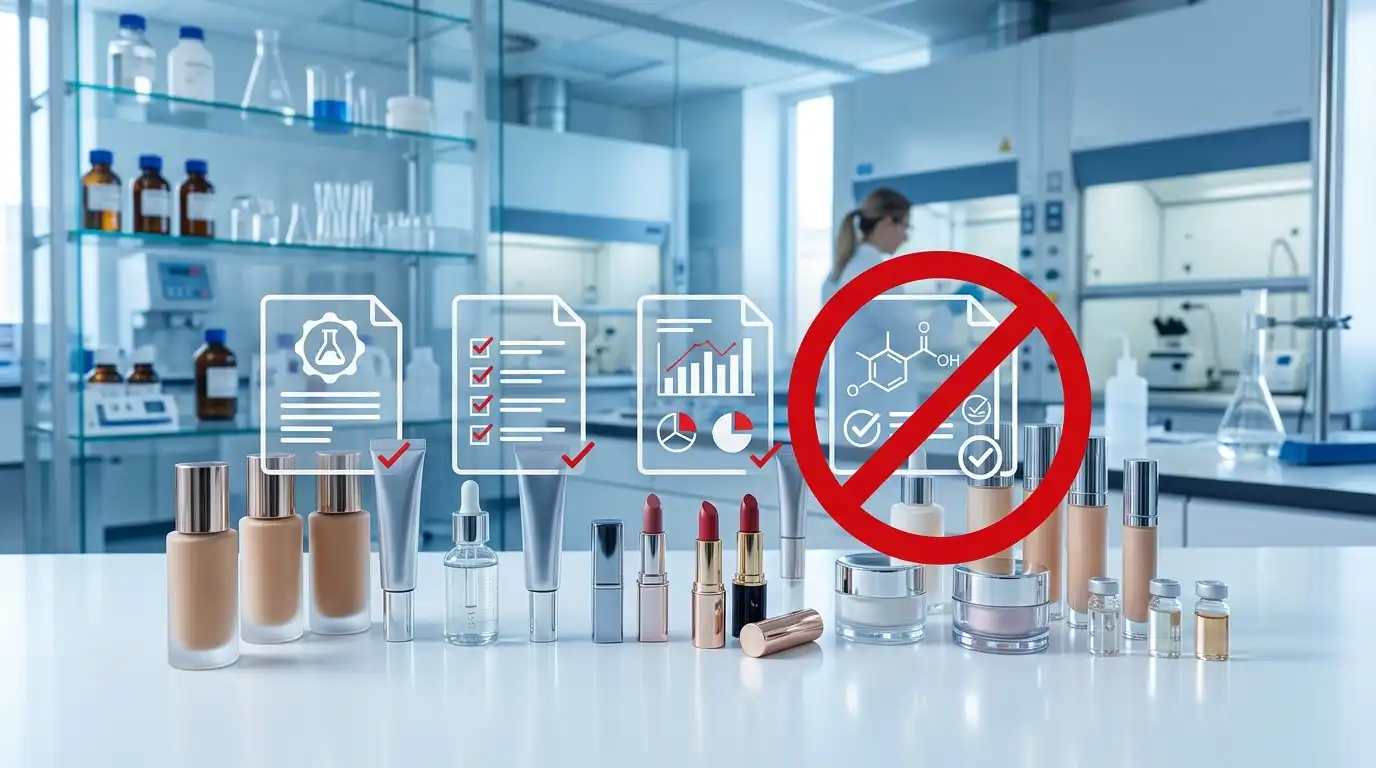
Since January 1, 2026, France has officially banned PFAS in cosmetics — a world first, based on Law No. 2025-188 of February 27, 2025 and implementing Decree 2025-1376 of December 28, 2025. If you are a white label brand or a brand owner working with a cosmetics laboratory, now is the time to act: audit your formulas, identify the substances concerned and plan your reformulation. The European Union is moving in the same direction (Omnibus VIII, REACH revision), and the United States is preparing its own FDA rules. This practical guide gives you everything you need to stay compliant, competitive and confident.
PFAS: definition, chemical families and why they are banned (in 90 seconds)
PFAS (Per- and Polyfluoroalkyl Substances) cover more than 10,000 synthetic molecules defined by their carbon-fluorine bond, one of the strongest in organic chemistry. That very strength is what makes them a problem: PFAS do not break down in the environment or in the human body. Hence their nickname, “forever chemicals”.
In cosmetics, they appear in several families:
- Perfluoroalkyl carboxylic acids (PFCA): PFOA, PFNA, PFDA — historically used as smoothing agents and water repellents.
- Perfluorosulfonic acids (PFSA): PFOS and derivatives — found in some surfactants and fixatives for long-wear makeup.
- Fluoropolymers: PTFE (polytetrafluoroethylene, aka Teflon®), used as a texturizing agent for a silky feel in foundations, lipsticks and powders.
- Fluorosilicones: rheology modifiers in serums and creams.
- Perfluorodecalin: oxygenating agent in some anti-aging products and masks.
PFAS carry documented health risks: endocrine disruption, immunotoxicity, suspected carcinogenicity (PFOA is classified as a Group 1 carcinogen by IARC), and accumulation in breast milk and blood. So the regulation comes as no surprise: it had been signaled for several years.
France: what has been BANNED since January 1, 2026 (concrete list)
Law No. 2025-188 of February 27, 2025 on per- and polyfluoroalkyl substances set up a phased ban. Decree No. 2025-1376 of December 28, 2025 specified how it applies to the cosmetics sector. Here is what has been banned in France since January 1, 2026:
- Placing on the market cosmetic products containing intentionally added PFAS, at any concentration — if the PFAS ingredient is deliberately formulated in, the product is non-compliant.
- PTFE (Polytetrafluoroethylene) in all its forms (micronized, powder) in cosmetic formulas: foundations, concealers, lipsticks, highlighters, loose powders.
- Perfluorodecalin (PFD) in oxygenating masks, serums and creams.
- Fluorinated fixing agents for long-wear products (waterproof mascara, eyeliner, 24-hour foundation).
- Fluorinated surfactants (perfluoroalkyl phosphate DEA, etc.) in any type of formula.
What is not banned yet (but worth watching): unintentional trace PFAS (supply chain contamination) are tolerated for now, with thresholds being set by the ANSM, the French medicines and health products agency. In practice, the prudent move is to audit your entire supply chain.
Penalties: in case of non-compliance, the ANSM can order the immediate withdrawal of batches, impose administrative fines and launch criminal proceedings for repeat offenses. For a white label product, both the manufacturer AND the brand owner are liable.
EU: Omnibus VIII + REACH proposal under way (2026-2028 timeline)
France is leading the way, but the European Union is not far behind. Here is the European regulatory timeline every brand operating in the EU should build into its planning:
- Universal PFAS restriction under REACH (2026): the European Chemicals Agency (ECHA) received a universal restriction dossier submitted jointly by Germany, the Netherlands, Sweden, Denmark and Norway. The public consultation closed in 2023; the final decision is expected during 2026, with sector derogations of up to 5 years depending on the use.
- Omnibus VIII — EU Cosmetics Regulation (2025-2026): the revision of Regulation (EC) No 1223/2009 adds specific PFAS provisions to Annexes II and III. Technical discussions are under way within the Scientific Committee on Consumer Safety (SCCS). An update to the annexes is expected by the end of 2026.
- Revised REACH Regulation (2027-2028): the European Commission is preparing a major overhaul of REACH that includes a group approach for chemical families such as PFAS — de facto banning the whole family rather than going substance by substance.
What it means for you: if you export to the EU (Belgium, Spain, Italy, Germany…), French compliance already puts you ahead. Use it to get ahead of EU obligations and avoid another reformulation rush in 2027.
USA: FDA NPRM proposal, May 2026 (getting ready for the US market)
The US market is on a similar path, but at its own regulatory pace. The FDA has announced an NPRM (Notice of Proposed Rulemaking) planned for May 2026 to regulate the use of PFAS in cosmetics sold in the United States.
- Current status (April 2026): several US states have already legislated — California (SB 54 + AB 1200), Colorado, Maryland and Minnesota have their own bans on PFAS in cosmetics, in force or imminent.
- FDA NPRM, May 2026: the federal proposal is expected to cover mandatory labeling of intentional PFAS and detection thresholds for traces. A 90-day public comment period will follow before the final rule (2027-2028 horizon).
- White label brands exporting to the USA: if your clients distribute in the United States, PFAS compliance is already a de facto requirement in the strictest states. PFAS-free formulas today guarantee your access to the US market without emergency reformulation.
The global trend is clear: within 3 to 5 years, intentional PFAS will have no place in any cosmetic formula intended for OECD markets. Acting now puts you ahead of your competitors.
6 hidden PFAS ingredients in your current formulas (audit checklist)
One of the most common traps for white label brands: PFAS hide behind INCI names that don’t shout “fluorine”. Here are the 6 most frequent suspects to track down in your technical data sheets:
- PTFE (Polytetrafluoroethylene) — exact INCI: “Polytetrafluoroethylene”. Found in: loose powders, matte foundations, long-wear lipsticks, concealers. Function: slip agent, silky feel, shine control.
- Perfluorodecalin — Found in: oxygenating masks, anti-aging serums. Function: carrying oxygen to the skin.
- Perfluorononyl Dimethicone — Found in: foundations, BB creams, primers. Function: texture and shine modifier.
- Bis-PEG/PPG-20/5 PEG/PPG-20/5 Dimethicone — Some variants contain fluorinated chains; check with your supplier.
- Perfluoroalkyl Phosphate DEA / MEA — Found in: some cleansers and makeup removers. Function: emulsifying surfactant.
- Fluorine-modified Triethoxycaprylylsilane — Found in: treated pigments (coating for water resistance). Check the surface treatment of your micas and oxides.
Immediate action: ask each of your ingredient suppliers for a written PFAS compliance statement (PFAS-free declaration) backed by analytical data (GC-MS or LC-MS/MS depending on the PFAS type). This documentation will be essential in the event of an ANSM inspection or client due diligence.
Technical substitutes: how to replace PFAS in your formulas (emulsions, UV, long-wear)
The good news: high-performance alternatives exist. The challenge is finding the right substitute for the function the PFAS performs in your formula. Here are the technical options validated by our R&D team:
Replacing PTFE (silky feel, mattifying control)
- Modified corn starch (e.g. Dry-Flo® PC) — very good shine control, comparable softness.
- Spherical silica (e.g. Silica Dimethyl Silylate) — excellent soft-focus effect, well-established use.
- Micronized carnauba wax — for lipsticks, provides slip without PTFE.
- Lauroyl Lysine — natural, biodegradable slip agent, excellent in loose powders.
Replacing fluorinated long-wear agents (mascara, eyeliner, foundation)
- Film-forming acrylic copolymers (e.g. Dermacryl®, Aculyn™ 33) — excellent wear, water resistance without fluorine.
- Trimethylsiloxysilicate resins — very good transfer resistance for foundations.
- Hydrophobic plant waxes (hydrogenated jojoba, rice bran wax) — for mascaras and eyeliners.
Replacing PFAS in emulsions and serums (Perfluorodecalin, fluorosilicones)
- Deodorized jojoba oil — good carrier for actives, good skin bioavailability.
- Plant-derived squalane — excellent replacement emollient for high-penetration serums.
- Cyclohexasiloxane (D6) or non-fluorinated Dimethicone — to keep emulsions light with a satin finish.
Every reformulation must be validated by accelerated stability testing (3 months at 40°C/75% RH), efficacy testing (wear tests for makeup, penetration for skincare) and, depending on the claim, dermatological or clinical testing. The R&D schedule depends on formula complexity and is defined with you in the quote.
How Carmel Cosmetics Labs supports your PFAS-free reformulation (audit + R&D + planning)
At Carmel Cosmetics Labs, we support white label brands from concept to market launch. PFAS compliance is no exception: we have built a structured 3-phase program so you can stay competitive without compromising on quality.
Phase 1 — PFAS audit of your existing formulas
- Systematic review of all your technical data sheets (INCI lists) for intentional PFAS.
- Collection of supplier compliance statements + laboratory analyses if needed.
- Full audit report with a priority list (red/orange/green) and recommended actions.
Phase 2 — R&D reformulation (scope set by formula complexity)
- Selection of the right technical substitutes for each affected SKU.
- Prototype development in the laboratory, with sensory and performance comparison against the original formula.
- Accelerated stability testing (ICH Q1A protocol adapted to cosmetics), packaging compatibility testing.
- Complete technical file to update the PIF (Product Information File).
Phase 3 — Production launch and regulatory documentation
- Industrial scale-up with pilot batch validation.
- PIF update, revised INCI labeling, compliance statement for your distributor clients.
- Support with your “PFAS-free” communication (claim validation, marketing wording).
Do you have formulas on the market that might contain PFAS? Don’t wait: regulatory deadlines are tight and qualified laboratories fill up fast. Contact our team today for a free initial assessment.
FAQ (Google “People also ask”)
Are PFAS really dangerous in cosmetics?
Yes. Epidemiological and toxicological studies confirm that PFAS build up in the body (bioaccumulation) and are linked to risks of endocrine disruption, immunotoxicity and, for some (PFOA, PFOS), carcinogenicity. Skin exposure through cosmetics adds to the overall body burden, especially for everyday products (foundation, lipstick that is partly ingested).
How can I tell if my cosmetic product contains PFAS?
Check the INCI list for terms containing “fluoro”, “perfluoro”, “polyfluoro”, “PTFE” or “fluoropolymer”. In addition, ask your contract laboratory or ingredient supplier for a written PFAS compliance statement. For analytical certainty, GC-MS or LC-MS/MS analyses can be run on the finished product.
What are the penalties if my product contains PFAS banned in France?
The ANSM can order an immediate market withdrawal, block the sale of non-compliant batches and impose administrative fines. In cases of deliberate endangerment or repeat offenses, criminal prosecution is possible. The responsible person placing the product on the market (the brand) is first in line, even if the contract manufacturer is involved.
How much does a PFAS-free reformulation cost?
The cost depends on formula complexity, the number of SKUs affected and whether additional testing is needed (stability, efficacy, tolerance). As a rule of thumb, budget between €1,500 and €8,000 per formula for a full reformulation project (development + testing + documentation). Contact Carmel Cosmetics Labs for a personalized quote for your range.
Can a “natural” or “organic” cosmetic contain PFAS?
PFAS are 100% synthetic substances and cannot be used in certified organic (COSMOS, ECOCERT) or natural cosmetics. However, cross-contamination from manufacturing equipment or packaging can theoretically introduce trace PFAS — which is why it is important to audit the entire production chain, including for “clean beauty” ranges.
My supplier says its ingredient is “PFAS-free” — is that enough?
A verbal or sales statement is not enough. Insist on a formal written statement (on letterhead, signed) backed by analytical data where possible. In a regulatory inspection, you will have to prove your due diligence. A statement without analytical data may fall short if the ANSM decides to inspect your batches.
Conclusion: PFAS compliance is a competitive advantage for white label brands
France’s ban on PFAS in cosmetics is not an isolated constraint — it is the start of a global regulatory wave that will reshape the industry. White label brands that act now will gain a decisive edge: they will be compliant before their competitors, ready for the European and US markets, and able to promote a “safe formulas” positioning to their distributor clients.
At Carmel Cosmetics Labs, we believe regulatory compliance is also an opportunity to reformulate better, with more sustainable and more transparent ingredients. Our R&D team is ready to support you, from the initial audit to the production launch of your new PFAS-free formulas.
Don’t let regulation catch you off guard. Contact Carmel Cosmetics Labs now for a free assessment of your formulas and a personalized action plan.