




Deodorant
Its astringent film limits the growth of odor-causing bacteria. It does not block sweat the way an antiperspirant does.
Services
Catalog
An active in mind?Ingredients glossaryIndustries
Laboratory
 Our factory in Aït MelloulGreater Agadir, Morocco
Resources
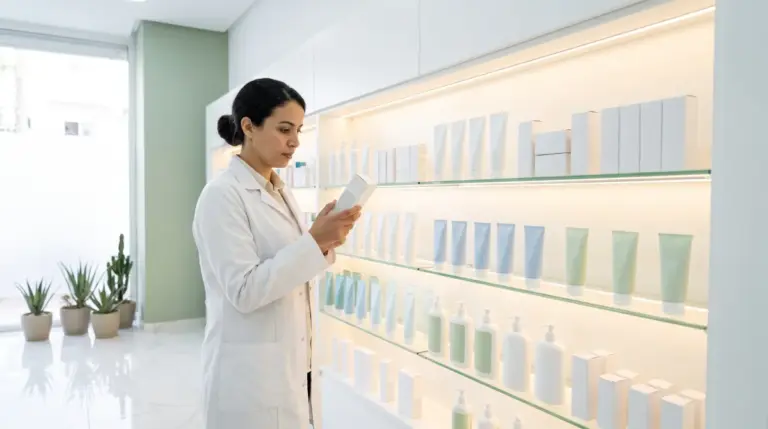 Study: dermocosmetics in MoroccoA MAD 2.77 billion market
The ore a mineral salt, potassium alum.
The crystal it forms perfect octahedrons.
The stone cut, polished, translucent.
The ritual moistened, it glides over the skin.
By the Carmel Cosmetics Labs R&D team · updated October 2, 2026
Alum stone is a crystal of potassium alum, a mineral salt with the formula KAl(SO₄)₂·12H₂O, a double sulfate of aluminum and potassium. Moistened and glided over the skin, it leaves a thin film with astringent properties. In cosmetics, it is used as a deodorant, as an aftershave and in foot care.
Mass proportions calculated from the formula KAl(SO₄)₂·12H₂O, rounded to the nearest unit.
INCI POTASSIUM ALUM. The natural mineral of the traditional alum stone. This is the one we use.
INCI AMMONIUM ALUM. A synthetic salt, sometimes sold as "alum stone". The INCI list tells them apart.
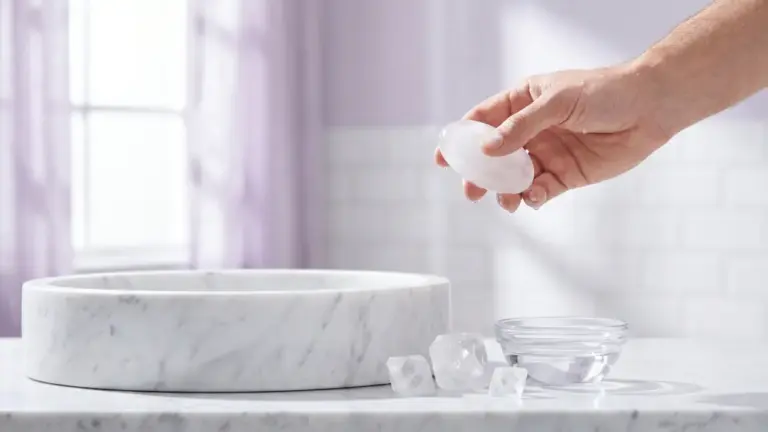
Its astringent film limits the growth of odor-causing bacteria. It does not block sweat the way an antiperspirant does.
Glided over damp skin after shaving, it tightens the skin and soothes razor burn. A traditional barber's ritual.
As a powder or solution, it is used in foot care for its drying, refreshing effect.
Moisten the stone and glide it over clean, dry skin, morning or evening.
Glide it over damp skin right after shaving, then rinse if needed.
Dry it after use: it dissolves in water and cracks if left wet.
We add it as a powder or solution to products ready to carry your brand. Choose a category to see the formulas.
What our formulators consider when alum stone goes into your product.
We stay within the limits set by the European SCCS assessment for each product type.
We use potassium alum and state it clearly in the INCI list.
"Natural", yes; "aluminum-free", never: alum is an aluminum salt.
Raw stone, stick, powder or solution: the format depends on your product and your sales channel.
Potassium alum naturally crystallizes into octahedrons, eight-sided crystals.
This is the Moroccan name for alum stone, found in barber kits and hammams.
Before cosmetics, alum was used as a mordant to fix colors on wool and leather.
Alum is an aluminum salt. In 2020, the EU Scientific Committee on Consumer Safety (SCCS) concluded that aluminum is safe in non-spray deodorants and antiperspirants up to 6.25% aluminum. Avoid applying it to broken skin or right after hair removal.
It limits odor thanks to its astringent effect, but it does not block sweat. It is a deodorant, not an antiperspirant.
Potassium alum (POTASSIUM ALUM) is the natural mineral. Ammonium alum (AMMONIUM ALUM) is made synthetically. The INCI list tells them apart.
Yes. Potassium alum is a double sulfate of aluminum and potassium. A product made with alum therefore cannot be called "aluminum-free".
Glide it over the still-damp skin right after shaving. It tightens the skin and soothes razor burn.
Its INCI name is POTASSIUM ALUM. This is the name that appears in the ingredient list.
Yes. We add it as a powder or solution to white label men's care, lotions and body care, or to an exclusive private label formula, made in our factory in Morocco.
Send your brief: we formulate and manufacture in our ISO 22716 factory in Aït Melloul. Formula selection and detailed quote, with no commitment.